
Ask ten cannabis users about anxiety and you’ll hear two very different stories. Some say THC is the only thing that helps them unwind. Others describe racing hearts, paranoia and panic attacks after a single gummy. Both experiences are real — and science helps explain why.
This guide covers how THC affects anxiety, why low and high doses can have opposite effects, which factors raise the risk of a bad reaction, what role CBD plays and what to do if you’ve taken too much.
Key takeaways
- THC has a biphasic relationship with anxiety: low doses may reduce it, while higher doses often increase it.
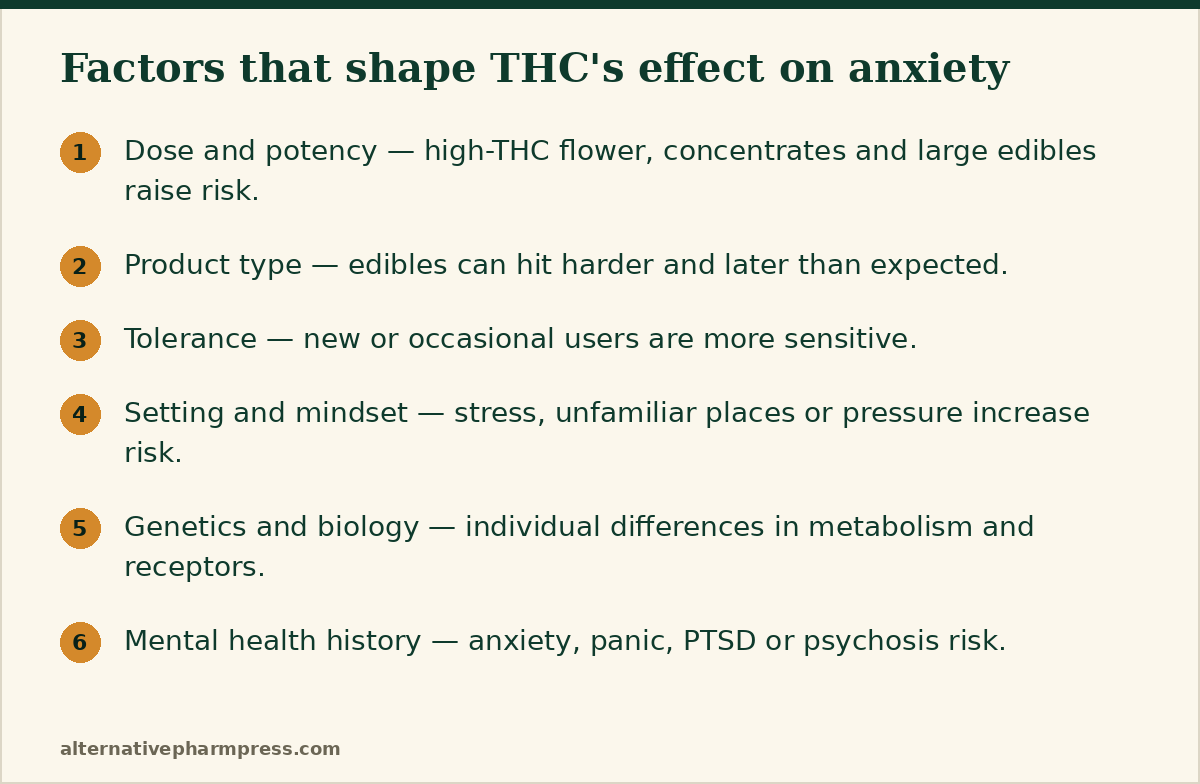
- Effects depend on dose, setting, genetics, tolerance, product type and mental health history.
- Edibles commonly cause overconsumption because of delayed onset.
- CBD may blunt some of THC’s anxiety-provoking effects, but evidence is mixed.
- Frequent high-THC use is linked to anxiety disorders, dependence and, in vulnerable people, psychosis.
How THC affects the brain’s anxiety circuits
THC acts mainly on CB1 receptors, which are widely distributed in brain areas that regulate fear, stress and emotion, such as the amygdala, prefrontal cortex and hippocampus. The body’s own endocannabinoids normally help dampen stress responses through this system.
When THC activates CB1 receptors, it can mimic that calming effect — up to a point. At higher doses, the effects can flip, increasing heart rate, heightening sensory input and amplifying threat perception. Part of this may involve THC’s effects on different neuron types and brain regions at different concentrations.
The biphasic effect
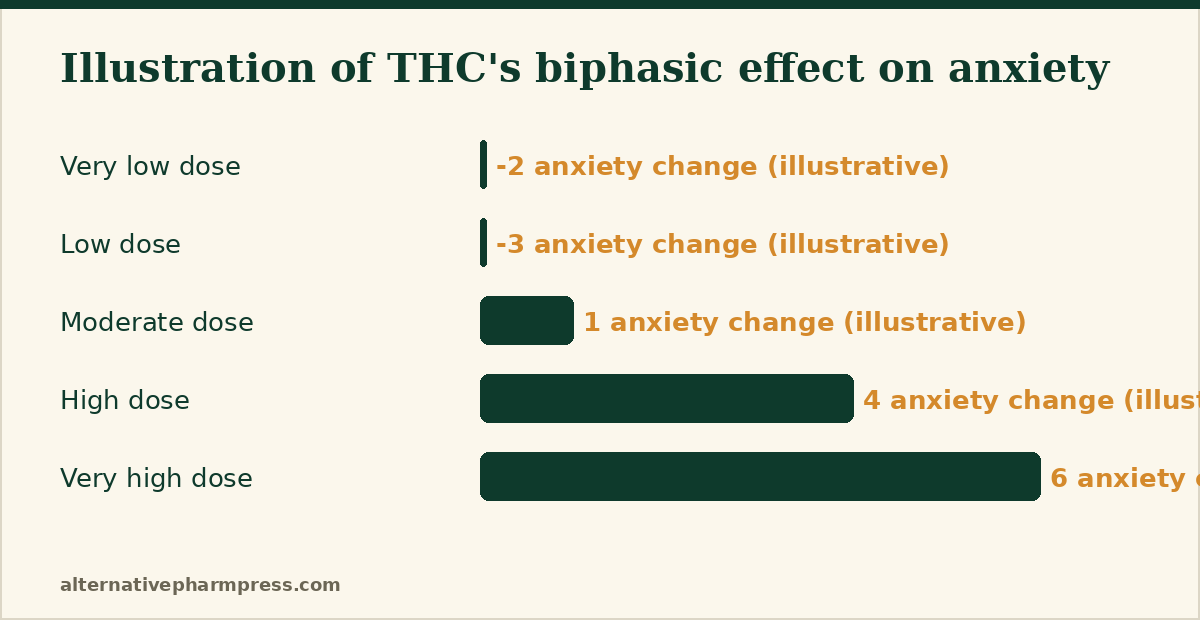
The chart is conceptual. Controlled laboratory studies have found that a low dose of THC reduced stress responses in some participants, while a higher dose increased anxiety and negative mood. The “sweet spot,” if there is one, varies widely between individuals.
Why the same dose affects people differently
Product type matters
- Smoked or vaped THC acts within minutes, so people can stop when they reach a comfortable level.
- Edibles take 30 minutes to two hours and produce 11-hydroxy-THC, which can feel stronger. Many panic episodes happen after someone takes a second edible because the first “didn’t work.” See delta-8 gummies guide.
- Concentrates like THCA live resin deliver very high doses quickly. See THCA live resin.
Potency has risen dramatically
Average THC levels in cannabis have climbed substantially over recent decades, and many hemp THCA products are just as strong. Higher potency makes it easier to overshoot into the anxiety-provoking range.
What about CBD?
CBD is often promoted as an anxiety-reducing counterweight to THC. Some studies found CBD reduced THC-induced anxiety or psychotic-like symptoms; others found little effect, or that results depended on the ratio and timing. CBD on its own has some evidence for reducing anxiety in experimental settings at relatively high doses. Read CBD meaning, THCA vs CBD and delta-8 vs CBD.
Products with balanced CBD:THC ratios (for example 1:1) may be gentler for some people, but they’re not guaranteed to prevent anxiety.
Long-term use and anxiety
Some people use THC daily to manage anxiety. The research picture is concerning:
- Dependence: regular use can lead to cannabis use disorder, and withdrawal includes irritability, insomnia and anxiety — which can feel like the original anxiety returning.
- Worsening symptoms: frequent heavy use is associated with higher rates of anxiety and depression, though cause and effect are debated.
- Psychosis risk: high-potency, frequent use is linked to increased risk of psychotic disorders, especially in adolescents and people with family history.
- Cannabis hyperemesis syndrome: severe cyclical vomiting in some long-term heavy users.
If you’re relying on THC to function day to day, it’s worth talking to a clinician about effective anxiety treatments such as CBT and medication.
What to do if you’ve taken too much THC
Too much THC is very unpleasant but rarely dangerous for healthy adults. Seek emergency care for chest pain, fainting, severe vomiting, confusion, seizures, or if a child or pet has eaten cannabis.
Practical steps that help many people:
- Remind yourself it will pass — peak effects usually fade within a few hours.
- Move somewhere calm and safe with someone you trust.
- Breathe slowly — for example, in for four counts, out for six.
- Hydrate and eat a light snack.
- Distract yourself with familiar music or a comforting show.
- Rest or sleep if you can.
- Avoid more substances, including alcohol.
Some people find CBD or black pepper helpful; evidence is limited.
Lower-risk approaches if you use THC
- Start low and go slow, especially with edibles (for example, 2.5 mg THC).
- Choose lower-potency products or balanced CBD:THC options.
- Avoid mixing with alcohol or other drugs.
- Use in a comfortable setting with people you trust.
- Take regular breaks to prevent tolerance and dependence.
- Avoid entirely if you have a personal or family history of psychosis or bipolar disorder.
THC, hemp products and the law
Hemp-derived THC products — delta-8, delta-9 hemp gummies, THCA flower — produce the same effects as marijuana-derived THC and carry the same anxiety risks. Legal status varies and is tightening under federal and state rules; see federal hemp law explained and delta-8 vs delta-9 THC.
Talking to a clinician
If you experience frequent anxiety, panic or low mood — with or without cannabis — a healthcare provider can help. Effective options include cognitive behavioral therapy, certain medications and lifestyle changes. Be honest about cannabis use so they can give accurate advice. For non-cannabis options people explore, see supplements for anxiety.
Why some people use THC for anxiety anyway
Many people report that small amounts of THC help them relax, sleep or manage stress, and some medical cannabis programs include anxiety-related conditions. Surveys of medical cannabis patients often list anxiety among the most common reasons for use. But surveys capture people who feel it helps; they miss people who stopped because it made things worse. Clinical trials specifically testing THC for anxiety disorders are limited, and existing evidence doesn’t support THC as a first-line treatment.
THC, sleep and next-day anxiety
THC can make it easier to fall asleep but tends to suppress REM sleep. When regular users stop, REM rebound can cause vivid dreams and disrupted sleep, which can worsen anxiety for a while. Some people also notice “next-day” anxiety or low mood after heavy use. Tracking how you feel the day after, not just during use, gives a more complete picture.
Who is most at risk of a bad reaction?
Some people are more likely to experience anxiety or panic from THC:
- New or infrequent users, who have no tolerance.
- People with anxiety or panic disorders, whose stress systems may already be sensitive.
- People with a personal or family history of psychosis, schizophrenia or bipolar disorder.
- Adolescents and young adults, whose brains are still developing.
- People taking high-potency products, such as concentrates or large edibles.
- Anyone using THC in an unfamiliar or stressful setting, or while sleep-deprived.
- People combining THC with alcohol or stimulants, which can increase heart rate and disorientation.
Panic attack or medical emergency?
THC-induced panic can feel frightening — a racing heart, shortness of breath and a sense of doom. These symptoms usually ease within hours. But some signs warrant medical attention: chest pain, fainting, a very fast or irregular heartbeat that doesn’t settle, severe vomiting, confusion, seizures or symptoms in someone with known heart disease. When in doubt, it’s always reasonable to seek medical help and tell staff what was taken.
How tolerance changes the picture
With regular use, the body adapts by reducing CB1 receptor availability. That’s why frequent users can take doses that would overwhelm a new user. But tolerance also means people may escalate doses over time, and when they stop, withdrawal symptoms — including anxiety, irritability and poor sleep — appear. Short tolerance breaks of a few days to a few weeks help reset sensitivity.
FAQ
Does THC help with anxiety?
Low doses may reduce anxiety for some people, but higher doses commonly increase it. Responses vary widely.
Why does THC make me paranoid?
High doses activate CB1 receptors in brain regions that process threat and emotion, which can amplify fear and paranoia, especially in sensitive individuals.
Does CBD stop THC anxiety?
CBD may reduce THC-induced anxiety for some people, but evidence is mixed and it’s not guaranteed.
How long does THC-induced anxiety last?
Usually a few hours as THC levels fall, though edibles can extend effects to six hours or more.
Is it safe to use THC for anxiety long term?
Frequent long-term use carries risks including dependence, worsening anxiety and, in vulnerable people, psychosis. Talk to a clinician about evidence-based treatments.