
Small, chalky tablets in brightly colored packs — often labeled “7-OH,” “7-hydroxy” or simply with a brand name and a milligram number — have become one of the fastest-growing products in smoke shops and gas stations. Many buyers assume they’re a stronger form of kratom. In reality, 7-OH tablets are a distinct product with a very different risk profile.
This guide explains what’s in 7-OH tablets, how to interpret strengths, why they’re associated with rapid dependence, what to look for on labels and where the law stands.
Key takeaways
- 7-OH tablets contain concentrated 7-hydroxymitragynine, usually made by chemically converting mitragynine.
- Common strengths are 10–30 mg per tablet, amounts impossible to get from kratom leaf.
- 7-OH is a potent mu-opioid agonist: tolerance and dependence can develop within days to weeks.
- Combining 7-OH with alcohol, benzodiazepines or opioids raises overdose risk.
- Many states ban or restrict 7-OH, and federal scheduling has been recommended.
What’s inside a 7-OH tablet
7-hydroxymitragynine is a kratom alkaloid that occurs naturally only in trace amounts in leaf, and is also produced in the body when mitragynine is metabolized. Commercial tablets are typically made by semi-synthesis — converting extracted mitragynine into 7-OH — then pressing it with binders and fillers into tablets. Some products also include mitragynine or other alkaloids. Read the basics in what is 7-OH.
Understanding the milligram numbers
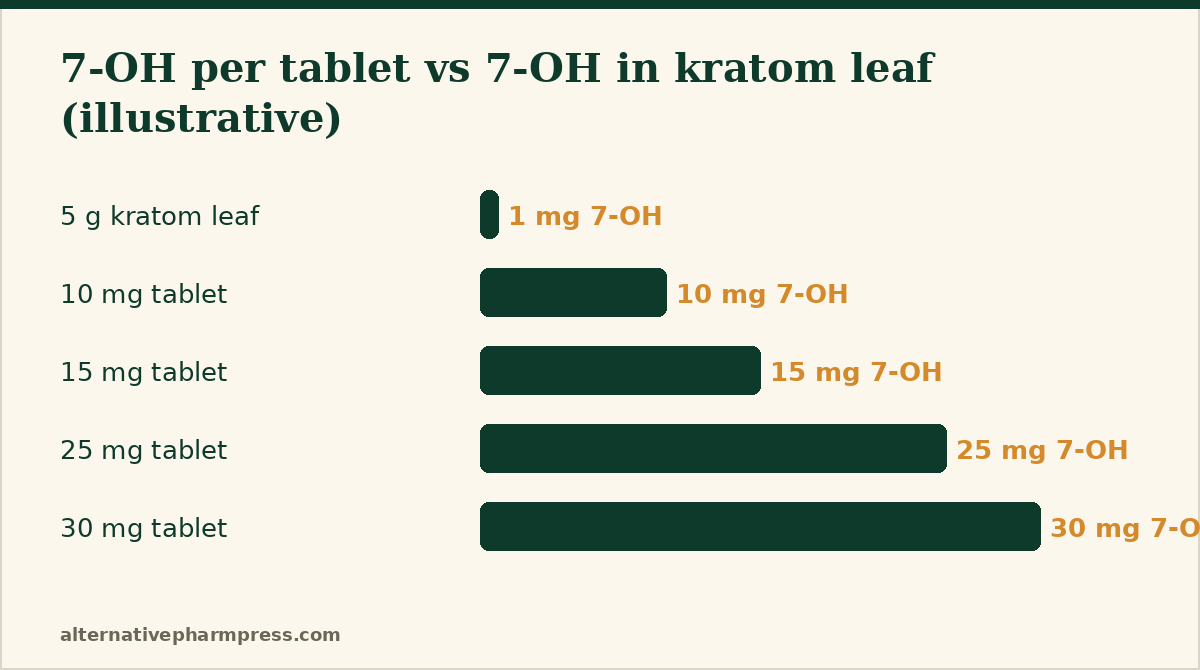
Natural kratom leaf contains roughly 0.01–0.05% 7-OH, often less. That means even a large 5 g serving of leaf contains around a milligram or less of 7-OH. A single 15 mg tablet can contain more than ten times that amount. This is the core reason 7-OH products behave so differently from leaf.
Some tablets are scored to be split, and packaging may suggest “half a tablet to start.” But because potency, absorption and individual sensitivity vary — and labels aren’t always accurate — dosing is unpredictable.
How 7-OH tablets feel and why that matters
People describe effects similar to prescription opioid pain relievers: pain relief, warmth, euphoria, calm and sedation, along with itching, nausea, constipation and pinpoint pupils. Effects typically start within 20–45 minutes and last several hours.
The euphoria is part of what makes these products risky. It encourages repeated dosing, and the rapid tolerance means people often find themselves taking more tablets, more often.
The dependence cycle
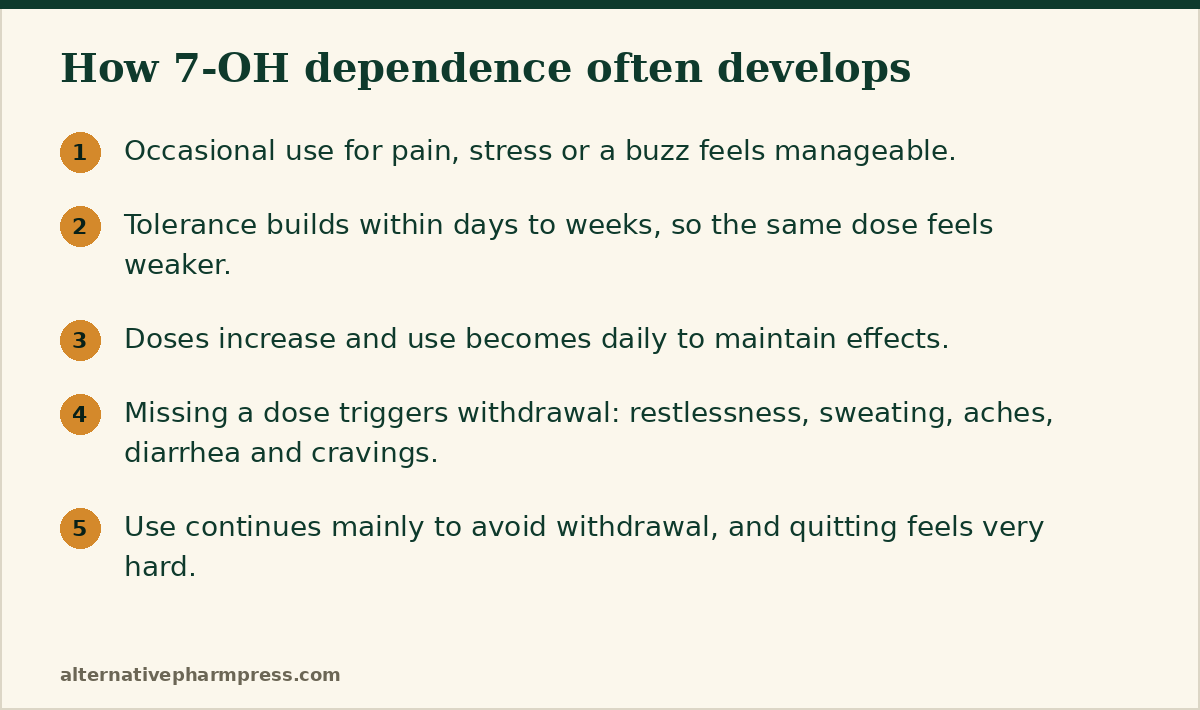
Withdrawal from regular 7-OH use resembles opioid withdrawal and can begin within hours of the last dose. Many people report it feels more intense than withdrawal from kratom leaf. See 7-OH withdrawal and the 7-OH tolerance overview.
Overdose and interaction risks
- Respiratory depression: high doses, especially combined with other depressants, can slow breathing.
- Dangerous combinations: alcohol, benzodiazepines (Xanax, Klonopin), gabapentin and pregabalin, sleep aids, other opioids.
- Hidden potency: labels may understate content, and switching brands can mean a much stronger tablet.
- Children and pets: tablets look like candy or medication; accidental ingestion can be life-threatening.
Emergency: If someone is very drowsy, can’t be woken, or is breathing slowly after taking 7-OH, call 911. Naloxone (Narcan) is available over the counter in the US and is believed to reverse 7-OH’s opioid effects.
Label red flags
When evaluating any 7-OH tablet (where legal), look out for:
- No milligrams per tablet or vague “proprietary blend” language.
- No batch-matched certificate of analysis from an accredited lab.
- Marketing as “kratom” while the alkaloid panel shows mostly 7-OH.
- Claims about treating pain, anxiety or withdrawal — these are illegal drug claims.
- Packaging that appeals to children or mimics candy.
- No age restriction or warnings, which many state laws require.
See kratom COA red flags and how to read a kratom lab report.
Tablets vs gummies vs shots
| Format | Typical features | Specific concerns |
|---|---|---|
| Tablets | Fixed mg per tablet; often scored | Easy to take multiple quickly; strengths escalate |
| Gummies | Candy-like, flavored | Accidental ingestion by children; uneven dosing |
| Shots and liquids | Concentrated, fast-acting | Very high per-serving doses |
| Vapes | Inhaled | Rapid onset; little research |
We compare tablets and gummies in 7-OH gummies vs tablets. Note that “best for new users” doesn’t mean safe — the safest choice for most people is avoiding concentrated 7-OH entirely.
Legal status
7-OH regulation is moving quickly:
- Federal: In 2025, the FDA recommended controlling 7-OH under the Controlled Substances Act and warned companies selling it. The DEA scheduling process and threshold debates are covered in our 7-OH scheduling update and FDA 7-OH news.
- States: Several states have banned 7-OH or limited it to natural trace levels in kratom products, and some, including Florida, moved to schedule it.
- Local: Some cities and counties have pulled 7-OH from shelves through emergency ordinances.
Check our kratom laws by state index — 7-OH rules are often stricter than kratom rules.
Drug testing
Standard five-panel tests usually don’t detect 7-OH, but expanded panels can, and testing is becoming more common in treatment and legal settings. See how long 7-OH stays in your system.
Getting help
If you’re using 7-OH tablets daily and struggling to stop, effective treatment exists. Clinicians increasingly use the same tools as for opioid dependence, including buprenorphine, alongside counseling and support. The SAMHSA National Helpline (1-800-662-4357) is free and confidential, 24/7. Read about buprenorphine-based treatment to understand what to expect.
Why tablet strengths keep rising
Over time, 7-OH tablet strengths on shelves have tended to climb — from single-digit milligrams to 15, 20, 30 mg or more. Part of this is marketing: higher numbers sell as “stronger” and “better value.” Part is tolerance: as regular users need more, brands compete to offer stronger products. This escalation is a classic pattern seen with other potent substances, and it increases risk for occasional or new users who pick up a high-strength product without realizing what it is.
What families should know
7-OH tablets are often sold in places teenagers can access, despite age restrictions in many states. Parents and caregivers should know what the packaging looks like and talk openly about the risks. Signs that someone may be using 7-OH regularly include pinpoint pupils, unusual drowsiness, constipation, mood swings, money problems and withdrawal-like symptoms (sweating, restlessness, diarrhea) when they go without. If you’re worried about a family member, SAMHSA’s helpline can point you to local support for families too.
How to taper safely if you use 7-OH daily
Stopping abruptly after regular use can trigger intense withdrawal. A medically supported taper is safer and more likely to succeed. Clinicians may recommend gradually reducing the dose over weeks, switching to a longer-acting medication such as buprenorphine, and treating symptoms like insomnia and diarrhea. Trying to taper by switching between products of different strengths is risky because potencies vary. Talk to a doctor or addiction medicine specialist before making changes.
Common myths about 7-OH tablets
“It’s just kratom, so it’s natural and safe.” 7-OH tablets are made by concentrating or chemically converting kratom alkaloids. The dose of 7-OH they deliver doesn’t exist in nature.
“It’s safer than prescription opioids.” Animal research suggests some differences in how 7-OH affects breathing, but that’s not proof of safety in people, particularly at high doses or with other depressants. Prescription opioids at least come with known doses and medical supervision.
“You can’t get addicted if you only use it on weekends.” Occasional use carries less risk than daily use, but tolerance can develop quickly, and many people who start occasionally end up using daily.
“Splitting tablets makes it safe.” Splitting helps lower a dose, but if the tablet’s content is inaccurate, a “half” could still be a strong dose.
“It won’t show up on a drug test.” Expanded panels can detect 7-OH, and testing is increasing.
FAQ
What are 7-OH tablets?
They’re pills containing concentrated 7-hydroxymitragynine, a potent kratom-derived opioid receptor agonist, usually made by converting mitragynine.
How strong are 7-OH tablets compared with kratom?
Much stronger at opioid receptors. A single 15 mg tablet can contain more 7-OH than many grams of kratom leaf.
Are 7-OH tablets addictive?
Yes. Tolerance and dependence can develop quickly, and withdrawal resembles opioid withdrawal.
Can you overdose on 7-OH tablets?
High doses, especially combined with other depressants, can cause dangerous sedation and slowed breathing. Call 911 in an emergency.
Are 7-OH tablets legal?
It depends on location. Several states ban or restrict 7-OH, and federal scheduling has been recommended.
How long do 7-OH tablets last?
Effects typically last several hours after onset at 20–45 minutes, though duration varies with dose and tolerance.
Can 7-OH tablets be used to quit opioids or kratom?
They’re not a recognized treatment and can create their own dependence. Evidence-based options such as buprenorphine or methadone, prescribed by a clinician, are safer and better studied.
What should I do if I find 7-OH tablets in my teen’s room?
Stay calm, talk openly about the risks, and watch for signs of regular use or withdrawal. A doctor or SAMHSA’s helpline can advise on next steps and family support.