
Capsules are the most beginner-friendly way kratom is sold. There’s no bitter taste, no measuring spoons, and they’re easy to carry. That convenience has made kratom capsules a best-seller for many vendors.
The trade-off is transparency. A capsule can hide how much kratom it contains, whether it’s plain leaf or a potent extract, and whether fillers are mixed in. This guide explains what to check so you know what you’re actually taking.
Key takeaways
- A standard “00” capsule holds about 0.5–0.6 g of kratom leaf powder; size “0” holds about 0.4–0.5 g.
- Capsules take a little longer to kick in than powder or drinks, because the shell must dissolve.
- Extract capsules can be many times stronger than leaf capsules of the same size.
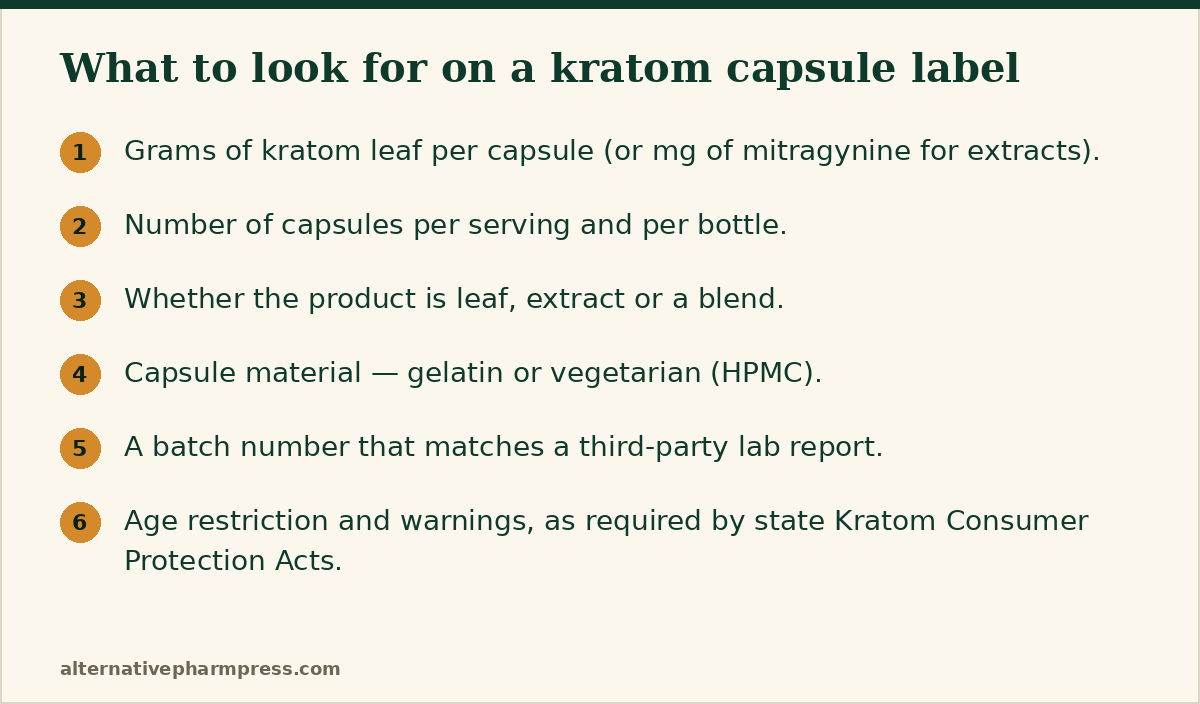
- Always check grams (or mg of mitragynine) per capsule and the number of capsules per serving on the label.
- A batch-specific lab report should cover alkaloids, heavy metals and microbes — and state whether 7-OH is present.
How much kratom is in a capsule?
Capsule size determines how much powder fits. Fine powder packs more densely than coarse powder, so exact amounts vary.
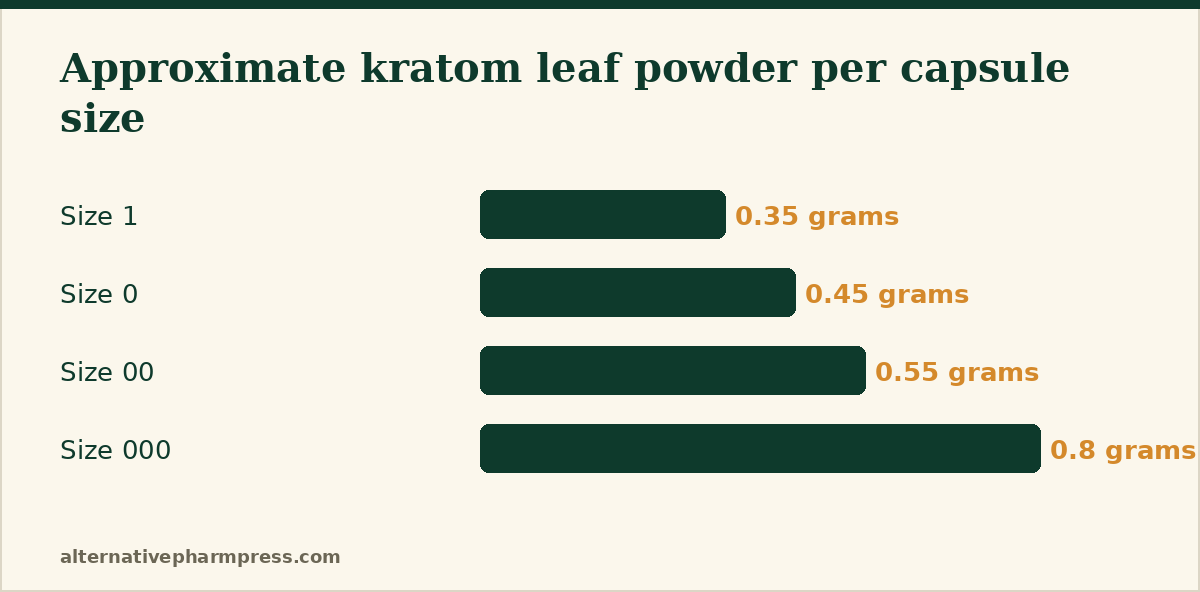
Because most vendors use size 00, a “serving” listed as five or six capsules often equals roughly 2.5–3.5 g of leaf. That’s why counting capsules without knowing the fill weight can lead to very different doses between brands. Our kratom capsules vs powder guide shows the conversion in more detail.
Why fill weights vary
- Powder density: ultra-fine powder packs more tightly.
- Machine vs hand filling: automated machines are more consistent.
- Fillers: some products add rice flour or other excipients, reducing kratom per capsule.
- Labeling practices: some vendors list “500 mg” capsules that actually average less.
Leaf capsules vs extract capsules
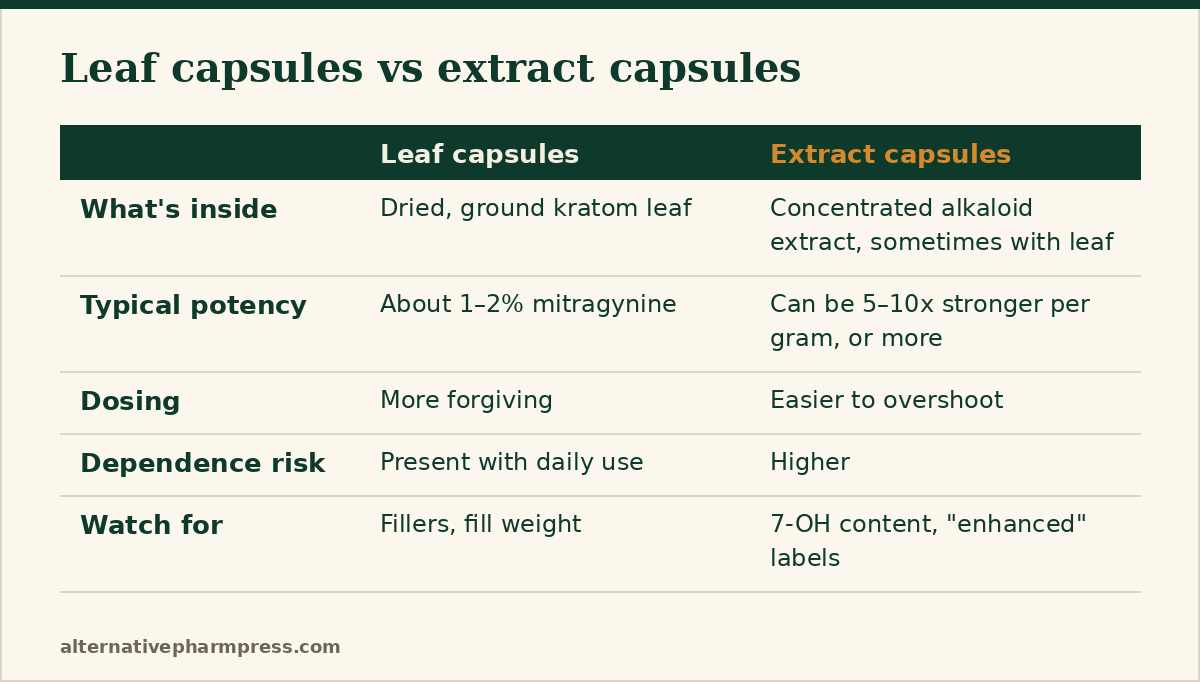
Extract capsules are a common source of surprise. A capsule that looks identical to a leaf capsule may contain a concentrated extract delivering several times more mitragynine — and some “enhanced” products contain 7-OH, which is far more potent. If a label says “extract,” “enhanced,” “max,” “plus” or lists milligrams of alkaloids rather than grams of leaf, treat it as a different product category. See what is 7-OH before buying anything enhanced.
How capsules compare with other formats
| Format | Onset | Taste | Dose control |
|---|---|---|---|
| Capsules | 30–60 minutes | None | Depends on fill weight accuracy |
| Powder (“toss and wash” or mixed) | 15–30 minutes | Bitter | Precise with a scale |
| Tea | 15–30 minutes | Bitter to mild | Precise if leaf is weighed |
| Drinks and shots | 15–30 minutes | Flavored | Depends on label accuracy |
Capsules take a little longer because the gelatin or vegetable shell must dissolve first. The slower onset can tempt people to take more before the first dose kicks in — a common mistake. For drink formats, see kratom drinks explained.
What a good capsule label shows
Reading the lab report
A trustworthy certificate of analysis (COA) for capsules should show:
- Alkaloid content: mitragynine and 7-hydroxymitragynine, ideally per gram or per capsule.
- Heavy metals: lead, arsenic, cadmium and mercury within safe limits.
- Microbial testing: salmonella, E. coli, total yeast and mold. Kratom has been the subject of FDA salmonella recalls.
- Batch matching: the COA should match the batch number on your bottle.
- Lab accreditation: ISO 17025-accredited third-party lab.
Learn the details in how to read a kratom lab report and the COA red flags to watch out for.
Do strains matter in capsules?
Vendors sell red, green and white capsule strains, just like powder. The same caveat applies: batch-to-batch alkaloid variation is often bigger than color differences. Read red vs white kratom, red vs green kratom and kratom strains explained for the background.
Safety considerations
- Dependence and withdrawal can develop with regular daily use; see kratom withdrawal and how kratom tolerance develops.
- Never combine kratom with alcohol, benzodiazepines, gabapentin or opioids. See kratom and alcohol.
- Liver injury is rare but documented; see kratom liver injury.
- Swallowing difficulty: large 000 capsules can be hard to swallow.
- Children and pets: capsules look like medication; store them securely.
New to kratom? Read our beginner’s guide to kratom and what kratom is used for before buying. Start with plain leaf capsules from a tested vendor, take the smallest serving, and wait at least an hour before considering more.
Capsules vs making your own
Some people buy empty capsules and a hand-filling tray to fill their own from powder. This can save money and let you choose the exact strain and fill. The downsides are time, mess and inconsistent fills unless you weigh each batch. If you go this route, weigh a sample of filled capsules on a milligram scale to calculate your average fill.
Is it legal to buy kratom capsules?
Capsules follow the same rules as other kratom products: legal federally, banned in some states, and regulated by Kratom Consumer Protection Acts in others, often with minimum ages and 7-OH limits. Check our kratom laws by state and the states that ban kratom before buying or traveling.
Choosing a vendor
Look for vendors who publish batch-specific COAs, list grams per capsule clearly, avoid health claims and comply with state laws. Our best kratom capsules and best kratom brands roundups only feature vendors with verifiable testing.
Gelatin vs vegetarian capsules
Capsule shells come in two main types. Gelatin capsules are made from animal collagen; they’re inexpensive and dissolve quickly in the stomach. Vegetarian capsules, usually made from hydroxypropyl methylcellulose (HPMC), suit vegans and people who avoid animal products for religious reasons. HPMC capsules can dissolve slightly more slowly and are less sensitive to humidity. Neither type meaningfully changes kratom’s effects, but if you have dietary restrictions, check the label — many vendors don’t specify unless you look closely.
Storing kratom capsules
Kratom alkaloids can degrade with heat, light and moisture. To keep capsules potent:
- Store them in the original airtight bottle with the desiccant packet inside.
- Keep them in a cool, dark cupboard — not a hot car or a bathroom.
- Avoid transferring capsules into unlabeled pill organizers for long periods; labels matter if anyone else finds them.
- Check the best-by date and the batch number so you can always match them to the lab report.
Common capsule mistakes
- Counting capsules instead of grams. Five capsules from one brand might be 2.5 g, while five from another could be 3.5 g.
- Switching from leaf to extract capsules at the same count. This can multiply the dose several times over.
- Redosing before the first dose kicks in. Capsules take longer than powder; wait at least an hour.
- Taking them on a completely empty stomach if you’re prone to nausea. A light snack can help.
- Daily use without breaks. Regular breaks reduce the risk of tolerance and dependence.
Calculating your real dose from capsules
If your vendor doesn’t publish the fill weight, you can estimate it yourself. Weigh ten capsules on a milligram scale, subtract the weight of ten empty capsules (a size 00 shell weighs roughly 0.1 g), and divide by ten. That gives your average kratom per capsule. For example:
- Ten filled capsules weigh 6.5 g.
- Ten empty size 00 shells weigh about 1.0 g.
- 6.5 − 1.0 = 5.5 g of kratom across ten capsules, or 0.55 g per capsule.
From there, you can convert a serving into grams of leaf and compare it with what you’d take as powder. If the product is an extract, the label should instead list milligrams of mitragynine per capsule; if it doesn’t, that’s a red flag.
Capsules and the “slow onset” trap
Because capsules kick in later than powder or drinks, people sometimes conclude a dose “isn’t working” and take more. Then both doses arrive at once, leading to nausea, dizziness or heavy sedation. A few habits help:
- Take capsules with a glass of water and wait a full 60 minutes before judging the effect.
- Note the time you took them.
- Keep the rest of the bottle out of reach while you wait, so you’re not tempted to redose.
- If you switch brands, start with fewer capsules than usual until you know the fill weight.
Who shouldn’t take kratom capsules
Kratom isn’t appropriate for people who are pregnant or breastfeeding, those with liver disease, anyone taking opioids, benzodiazepines, gabapentinoids or other sedatives, and people with a history of substance use disorder. If you take any prescription medication, ask a pharmacist about interactions — kratom alkaloids are processed by liver enzymes (CYP3A4 and CYP2D6) that also handle many common drugs.
FAQ
How much kratom is in one capsule?
A size 00 capsule typically holds about 0.5–0.6 g of leaf powder, though fill weights vary by vendor and powder density.
Do kratom capsules work slower than powder?
Usually a little slower, often 30–60 minutes, because the capsule shell needs to dissolve first.
Are kratom extract capsules stronger?
Yes. Extract capsules can be several times stronger than leaf capsules of the same size, and some contain 7-OH. Check the label carefully.
How many kratom capsules equal a gram?
About two size 00 capsules hold roughly one gram, but weigh a sample to be sure for your specific product.
What should a kratom capsule lab report include?
Mitragynine and 7-OH content, heavy metals, microbial testing, a matching batch number and the name of an accredited third-party lab.
Does kratom show up on a drug test?
Standard 5- and 10-panel workplace tests don’t look for mitragynine, kratom’s main alkaloid, so kratom usually won’t trigger them. Specialized tests can detect it, and some employers, courts and treatment programs use them.
Does kratom cause constipation?
Yes, constipation is one of the most common side effects of regular kratom use, because its alkaloids slow the gut the way opioids do.