
If you’ve walked into a smoke shop or gas station recently, you may have seen small tablets, gummies or shots labeled 7-OH. They are often displayed next to kratom and sometimes marketed as “kratom” — but they are a very different product. Regulators, doctors and even many kratom advocates have raised alarms about them.
So what is 7-OH, why is it different from regular kratom, and what should you know before you encounter it? This guide explains it in plain English.
Key takeaways
- 7-OH is short for 7-hydroxymitragynine, an alkaloid found in tiny amounts in kratom leaves.
- It binds opioid receptors far more strongly than mitragynine, kratom’s main alkaloid.
- Modern 7-OH products are concentrated or semi-synthetic, delivering doses that natural leaf never would.
- Risks include rapid tolerance, dependence, withdrawal and overdose, especially combined with other depressants.
- Regulators have moved to restrict or schedule 7-OH; several states already ban it.
7-OH in one sentence
7-hydroxymitragynine is a naturally occurring kratom alkaloid — and a metabolite of mitragynine — that acts as a potent opioid receptor agonist, now sold in concentrated forms that make it behave much more like an opioid drug than like kratom leaf.
Where 7-OH comes from
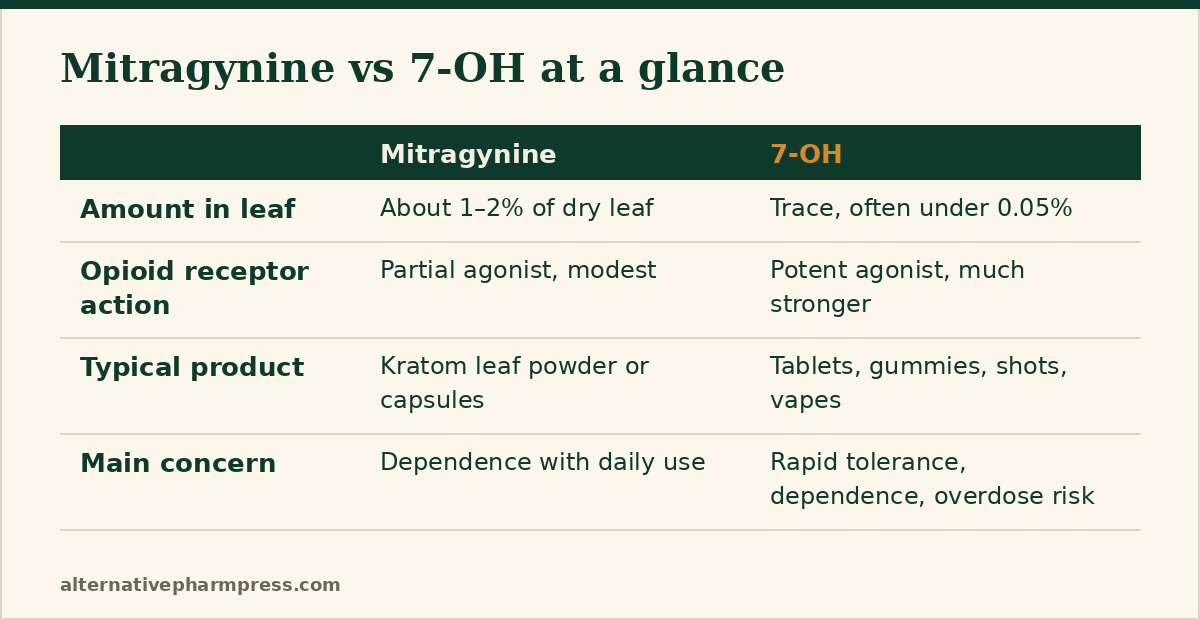
Kratom leaves (Mitragyna speciosa) contain dozens of alkaloids. Mitragynine is the most abundant, usually about 1–2% of dried leaf. 7-hydroxymitragynine is present in only trace amounts — typically well under 0.05% of dry leaf, and often barely detectable in fresh leaf.
The body also makes 7-OH: when you consume mitragynine, liver enzymes (mainly CYP3A4) convert part of it into 7-OH. Researchers now think this metabolite may be responsible for a meaningful share of kratom’s opioid-like effects. We explain this in mitragynine vs 7-hydroxymitragynine and in our deeper 7-OH and the blood-brain barrier overview.
Why 7-OH products are different from kratom
Traditional kratom is a plant product: you consume ground leaf containing a natural ratio of alkaloids, with mitragynine dominant and 7-OH tiny. Modern 7-OH products flip that ratio:
- They are made by isolating, concentrating or chemically converting alkaloids — often converting mitragynine into 7-OH in a lab.
- A single tablet may contain 10–30 mg or more of 7-OH. To get that from leaf, you would need to consume an impossible quantity of kratom.
- The resulting effects are more opioid-like: stronger euphoria, sedation and pain relief, with faster tolerance.
This is why many kratom vendors and advocacy groups have distanced themselves from 7-OH, and why regulators treat it separately. Our explainer on 7-OH vs traditional kratom goes deeper.
What does 7-OH feel like?
People who use 7-OH products describe effects similar to opioid pain relievers:
- Pain relief and physical relaxation
- Euphoria or a warm, calm feeling
- Sedation and drowsiness, especially at higher doses
- Itching, constipation, nausea and constricted pupils
Effects often begin within 20–40 minutes for tablets and last several hours. Because potency varies widely between brands and even between batches, the same “one tablet” dose can feel very different.
The risks of 7-OH
Tolerance and dependence
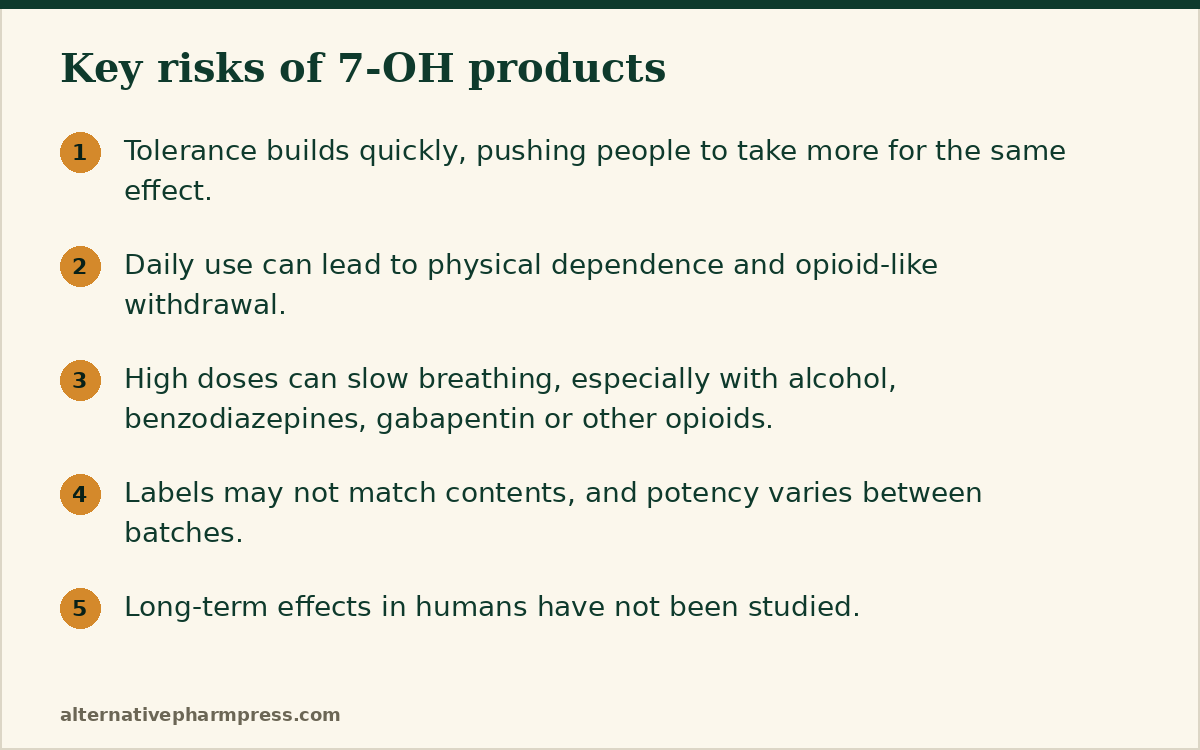
Because 7-OH acts strongly on mu-opioid receptors, tolerance can build within days to weeks of regular use. Many people report needing more tablets for the same effect. Our 7-OH tolerance overview explains the mechanism.
Withdrawal
Stopping after regular use can trigger opioid-like withdrawal: anxiety, restlessness, sweating, runny nose, muscle aches, diarrhoea, insomnia and strong cravings. People who have used both often say 7-OH withdrawal feels more intense than kratom leaf withdrawal. See our guide to 7-OH withdrawal.
Overdose and respiratory depression
Animal research suggests 7-OH may cause less respiratory depression than morphine at equivalent pain-relieving doses, but this is not a safety guarantee — especially at the high doses in some products, or when combined with other depressants. Poison control centers have reported rising calls involving 7-OH.
If someone is unresponsive or breathing slowly after taking 7-OH or any opioid-like substance, call 911 immediately. Naloxone (Narcan), available over the counter in the US, can reverse opioid effects and is believed to work on 7-OH as well.
Product quality
7-OH products are largely unregulated. Labels may not match what’s inside, and “kratom” packaging can hide concentrated 7-OH. Read the COA red flags guide before trusting any label.
Is 7-OH legal?
7-OH’s legal status is changing fast:
- Federal: In 2025 the FDA recommended that 7-OH be scheduled under the Controlled Substances Act and issued warnings to companies selling 7-OH products. The DEA’s scheduling process and the debate over thresholds are covered in our 7-OH scheduling update and FDA 7-OH news.
- States: Several states have banned or emergency-scheduled 7-OH, and others have passed laws limiting the amount of 7-OH allowed in kratom products (often expressed as a maximum percentage of total alkaloids). Florida, for example, moved to schedule 7-OH in 2025.
- Kratom Consumer Protection Acts: Many state KCPAs now cap 7-OH content in kratom products. See our KCPA explainer.
Check our kratom laws by state index and the states that ban kratom list before buying, and note that 7-OH rules may be stricter than kratom rules in the same state.
How 7-OH products took off
For most of kratom’s modern history in the US, 7-OH was a footnote. Researchers knew it existed and that it was potent, but commercial kratom was sold as dried leaf powder or capsules. That changed in the early 2020s.
A few developments came together. Chemists and manufacturers learned that mitragynine could be converted into 7-OH relatively easily, creating a product that was far stronger by weight than leaf. Small, discreet formats — tablets, gummies and later vapes — made it easy to sell in smoke shops and convenience stores. And because 7-OH comes from kratom, sellers could market it under the kratom umbrella, outside the controls that apply to prescription opioids.
Sales grew quickly. So did reports to poison control centers, emergency room visits and stories from people who found themselves dependent after only weeks of use. By 2025, federal regulators, state attorneys general and several kratom trade groups were all calling for limits. Some long-standing kratom vendors began testing and certifying that their products contained only natural levels of 7-OH, to separate themselves from the concentrated market.
The result is today’s patchwork: in some places 7-OH tablets are still on shelves, while in others they have been pulled overnight. Expect the rules to keep changing through 2026.
Why “natural” doesn’t mean safe here
7-OH sellers sometimes describe their products as “natural” or “plant-based” because the compound originally comes from kratom. That framing is misleading. Morphine also comes from a plant, but nobody would call a morphine tablet a herbal supplement. What matters is the dose and potency of what you consume — and concentrated 7-OH delivers opioid-receptor activity at levels that kratom leaf never could.
7-OH on drug tests
Standard five-panel drug tests don’t detect 7-OH, but expanded panels and specialised tests can. How long it stays detectable depends on dose, frequency and the test used. We cover the timelines in how long does 7-OH stay in your system.
If you’re struggling with 7-OH
If you find it hard to cut back on 7-OH, you are not alone, and effective help exists. Clinicians increasingly treat 7-OH dependence like other opioid dependence, using medications such as buprenorphine alongside counseling. Talking to a doctor, an addiction medicine specialist or calling the SAMHSA National Helpline (1-800-662-4357, free and confidential, 24/7) is a good first step. Read about buprenorphine-based treatment for kratom dependence for an overview of how treatment works.
How to tell if a product contains 7-OH
7-OH isn’t always obvious from the front of the package. Some products are labeled simply as “kratom,” “mitragynine alkaloids” or “botanical extract.” Before buying any kratom-type product, check for these warning signs:
- “7-OH,” “7-hydroxy” or “7OH” anywhere on the label, including in small print or the supplement facts panel.
- Milligram doses of alkaloids per tablet that are far higher than you’d get from a few grams of leaf.
- Tablet, gummy or “shot” formats sold in very small packs with strong potency claims.
- Names or marketing that emphasise strength — “extra strength,” “plus,” “max,” or comparisons to pain medications.
- A certificate of analysis that lists 7-OH as a major alkaloid rather than a trace component. In natural leaf, 7-OH is typically a tiny fraction of total alkaloids.
If a product’s lab report doesn’t break down individual alkaloids, treat that as a red flag. Our guide to reading a kratom lab report shows exactly where to look.
7-OH vs other kratom formats
To put 7-OH in context, here’s how it compares with the kratom formats most people know:
- Leaf powder and capsules — natural alkaloid ratio, mostly mitragynine, effects scale gradually with dose. See what kratom is used for.
- Kratom extracts — concentrated mitragynine, stronger per gram, higher dependence risk than leaf.
- 7-OH tablets and gummies — concentrated or converted 7-OH, opioid-like potency, the highest dependence and overdose risk of the group. See 7-OH gummies vs tablets.
FAQ
What does 7-OH stand for?
7-OH stands for 7-hydroxymitragynine, an alkaloid found in small amounts in kratom leaves and produced in the body when mitragynine is metabolised.
Is 7-OH the same as kratom?
No. 7-OH is one compound found in trace amounts in kratom. Concentrated 7-OH products are far more potent at opioid receptors than kratom leaf.
Is 7-OH an opioid?
7-OH is not a classical opioid drug, but it is a potent agonist at mu-opioid receptors and produces opioid-like effects, tolerance and withdrawal.
Can you overdose on 7-OH?
High doses, especially combined with alcohol, benzodiazepines or other opioids, can cause dangerous sedation and slowed breathing. Call 911 if someone is unresponsive.
Is 7-OH legal in my state?
It depends. Several states ban or restrict 7-OH, and federal scheduling has been recommended. Check current state law before buying.
When will the 7-OH ban take effect?
The DEA’s October 2026 notice said a temporary order could be published on or after 13 November 2026. As of 22 November 2026 it had not been published. It takes effect on the day it appears in the Federal Register.
What drinks have 7-OH?
7-OH shows up in some "kratom shots," tablets and gummies sold in smoke shops and gas stations, often at concentrations far above natural leaf. Labels aren’t always accurate, which is one reason regulators are targeting these products.