
Disclosure: Some links on this page go to brands we cover. We may earn a commission if you buy through them, at no extra cost to you. This does not change our ratings. How we make money.
This article is for educational and informational purposes only. It does not constitute medical advice.
Legal update — October 15, 2026: On October 14, 2026, the U.S. Drug Enforcement Administration published notice that it will temporarily place 7-hydroxymitragynine (7-OH) and mitragynine pseudoindoxyl in Schedule I of the Controlled Substances Act when either exceeds 1 mg per gram of a product, or when the ratio of mitragynine to these compounds is below 100. The order can take effect on or after November 13, 2026 and would last two years. The 7-OH tablets described in this review, including the house-brand tablets listed at 80 mg of 7-OH each, are far above that threshold. Once the order takes effect, manufacturing, selling or possessing them would be illegal under federal law. The FDA had recommended scheduling concentrated 7-OH products in July 2025, and kratom is banned outright in nine states. This review describes products as they were offered in May 2026; it is not an endorsement or legal advice. See the Federal Register notice and our state-by-state legal guide.
About 7OH.com
7OH.com operates as a specialized marketplace for 7-hydroxymitragynine (7-OH) kratom alkaloid products, with catalog architecture built around concentration. Products are organized by potency range — 5mg to 25mg, 25mg to 50mg, 50mg to 75mg, and 75mg to 100mg per tablet. For background on what 7-OH is, see our alkaloid comparison guide.
Multi-Dated COA Transparency
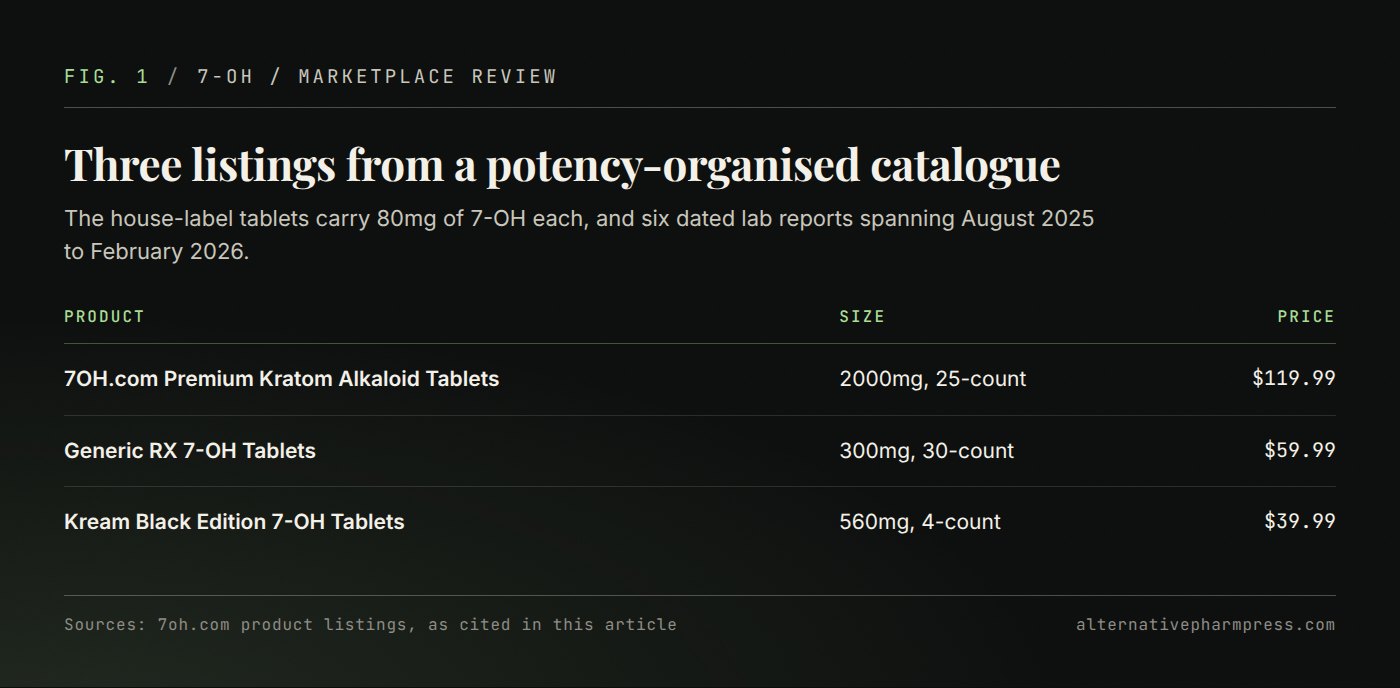
Rather than publishing a single COA per product, 7OH.com product pages display multiple dated COAs across different test periods. The house brand 2000mg, 25-count tablets carry six dated lab reports spanning August 2025 through February 2026. To evaluate these reports, see our Kratom COA Guide.
Product Catalog
The platform carries Kream, Generic RX, Modus, Opia, and its own house label: 7OH.com Premium Kratom Alkaloid Tablets (80mg 7-OH per tablet, five flavors). Formats include tablets, shots, powders, gummies, edibles, disposables, syrups, and strips.
Featured Products
- 7OH.com Premium Kratom Alkaloid Tablets (2000mg, 25-count, $119.99) — Six dated COAs listed on the product page.
- Generic RX 7-OH Tablets (300mg, 30-count, $59.99) — $2.00 per tablet.
- Kream Black Edition 7-OH Tablets (560mg, 4-count, $39.99)
B2B Distribution & Shipping
7OH.com serves direct-to-consumer and B2B buyers. Free Priority Shipping on orders $189+. Support: help@7oh.com or (754) 300-0059, Mon–Fri.
State Restrictions
As of October 2026, kratom is banned outright in Alabama, Arkansas, Connecticut, Indiana, Louisiana, Massachusetts (temporary emergency order), Tennessee, Vermont and Wisconsin, Ohio bans processed kratom products, and several counties and cities have local bans. Federal Schedule I control of concentrated 7-OH can take effect from November 13, 2026. See our Kratom Legal Status by State guide.
2026 update: testing, labels and legal status
7OH.com is a multi-brand retailer rather than a manufacturer, so quality depends on the brand behind each listing. When we checked the site on 24 October 2026, it carried brands including 7Stax, Opia, Press’d, Kream, Generic RX, Hydroxie, 7ohmz and 7-O-Heaven, across tablets, shots, gummies and other edibles, powders, capsules, syrups, strips and disposable vapes. We have reviewed one of those brands separately in our 7Stax review.
What to check per brand. The homepage we reviewed showed potency and count details but no certificates of analysis, so look on each product page or the maker’s own website. For any 7-OH product, a useful COA should:
- match the batch or lot number printed on the package you receive;
- name the testing lab and give a test date;
- quantify 7-OH and mitragynine, and flag mitragynine pseudoindoxyl, which the DEA placed in Schedule I in August 2026;
- show 7-OH per unit close to the label claim;
- include heavy metal and microbial results for powders and edibles.
Federal status. On 14 October 2026 the DEA published a revised notice of intent (91 FR 65370) to temporarily place 7-OH in Schedule I when a product holds more than 1 mg per gram (solids) or 1 mg per millilitre (liquids), or has a mitragynine-to-7-OH ratio below 100. Shots and syrups are measured against the per-millilitre limit and tablets against the per-gram limit; multi-milligram products in either form sit well above the line. The order cannot be published before 13 November 2026, and plain kratom leaf is not covered. Our explainer on where DEA 7-OH scheduling stands tracks each step.
State rules. 7OH.com states that it does not ship to seven states, including Florida and Alabama, or to several counties. Florida has scheduled concentrated 7-OH by emergency rule since August 2025, and North Dakota and Massachusetts issued emergency orders in August 2026, so check local rules before ordering.
Dependence risk. The DEA cites tolerance, dependence, addiction and respiratory depression among 7-OH’s risks, and stopping regular use can bring withdrawal. Our guide to 7-OH withdrawal covers symptoms and support, and SAMHSA’s free National Helpline is open 24 hours a day on 1-800-662-4357.
Before you buy any 7-OH product in late 2026
Brand quality is only part of the picture. Three things matter more than which seller you choose.
The legal ground is moving. The DEA’s October 2026 notice would place 7-OH above a set concentration in Schedule I, and the order can be published any day. On that day, products like these would become federally controlled, and retailers may pull stock with little warning. Several states already ban or cap 7-OH.
Potency is the main risk. Concentrated 7-OH acts strongly on opioid receptors. Dependence can develop quickly with daily use, and combining it with alcohol, benzodiazepines, sleep aids or other opioids raises the risk of dangerously slowed breathing. Keep naloxone on hand if anyone in your home uses these products.
Lab reports need checking, not just reading. Confirm the batch number matches your package, the lab is accredited and independent, and the report tests for contaminants as well as alkaloid content.
If you’re finding it hard to cut back, our guide to 7-OH withdrawal explains the options, and SAMHSA’s free helpline (1-800-662-4357) can connect you with treatment.
Questions to ask any 7-OH seller
A good seller should answer these without hesitation. If it can’t, treat that as a warning sign.
- Which lab tested this batch, and can I verify the report with the lab directly? An accredited, independent lab and a matching batch number are the minimum.
- How much 7-OH and mitragynine are in each unit, measured rather than estimated? Label claims and lab results should match within a reasonable margin.
- Is the 7-OH extracted from leaf or made semi-synthetically? Sellers rarely disclose this, but it affects what else may be in the product.
- What happens to my order if the DEA order publishes? Ask about refunds and shipping cutoffs, especially for subscriptions.
- Do you ship to my state? A seller that ships to states where 7-OH is banned is ignoring the law, which says something about its other practices.
Frequently Asked Questions
How does 7OH.com organize its products?
By potency range (mg of 7-OH per tablet), making direct concentration comparison straightforward.
Is 7-hydroxymitragynine legal?
Not for much longer at the federal level. On October 14, 2026 the DEA published notice that it will temporarily place 7-OH above 1 mg per gram in Schedule I, effective no earlier than November 13, 2026. Concentrated 7-OH tablets exceed that limit. Several states already restrict or ban 7-OH. Verify your local laws — see our legal guide.
Not medical advice. Not evaluated by FDA. For adult use only — 21+. Alternative Pharm Press does not sell any products featured in this article.
Does 7OH.com test the products it sells?
We could not confirm a store-wide testing programme. On our October 2026 check, the homepage listed potency and tablet counts but showed no certificates of analysis. Because the store stocks many brands, testing depends on each manufacturer. Ask the brand or the store for a batch-matched COA, and do not rely on the potency figure in a product title on its own.
Are 7-OH shots treated differently from tablets under the DEA notice?
Only in how the threshold is measured. Liquids are covered above 1 mg of 7-OH per millilitre and solids above 1 mg per gram, and either form is also covered if its mitragynine-to-7-OH ratio is below 100. The DEA’s notice cites a 90 mg liquid shot among products on the market, a strength far above the liquid limit.
Is 7-OH legal right now?
Federally, 7-OH was not yet scheduled as of 22 November 2026, but several states ban or restrict it, and the FDA has warned companies selling it. Check your state’s law and expect the federal position to change.