

Kratom strains are trade names, not botanical varieties. Every red, green, white, gold, Maeng Da, Bali or Borneo product is leaf from the same species, Mitragyna speciosa. The colour usually reflects the powder or drying method, and place names are rarely verifiable. In the one study that tested both, users reported differences the lab could not find.1,2
That does not mean every bag is identical. Kratom’s alkaloid content varies a great deal with season, growing region, leaf age and how the leaves were withered and dried.3,2,4 The problem is that the name on the pack does not tell you which of those factors applies.
This hub explains what each part of a kratom strain name means, what sellers claim, what laboratory and field research has measured, and what to check instead. It links to our detailed comparisons of individual strains and gives no dosing advice.
At a glance
| Question | What the evidence shows |
|---|---|
| Are strains different plants? | No. All are Mitragyna speciosa leaf |
| Is there an official strain standard? | None from any regulator or pharmacopoeia |
| Does colour predict alkaloids? | Not in tested retail products1 |
| What changes powder colour? | Drying temperature and withering time2 |
| What changes alkaloid content? | Season, region, leaf age, cultivar and post-harvest handling3,2,4 |
| Do users report differences? | Yes, on 6 of 39 effect scales in one survey1 |
| Blinded human trials comparing strains | None |
| Better guide than the name | Batch-matched certificate of analysis (COA) |
What “kratom strains” actually means
A typical strain name stacks two or three labels: a vein colour (red, green, white, sometimes gold or yellow), a place (Bali, Borneo, Malay, Thai, Sumatra) and sometimes a grade or style (Maeng Da, “super”, “enhanced”). Sellers present each combination as a product with its own personality.
In kratom’s native Southeast Asia, no such colour distinction is traditionally made, and strains are not advertised with distinct effects.1 The naming system grew up in Western retail. Each label points loosely at something real, such as vein colour, origin or processing, but none is defined by a regulator or industry standard, so two sellers can use the same name for different material.
If you are new to kratom itself, start with our plain-language guide, what is kratom, then come back to the naming questions here.
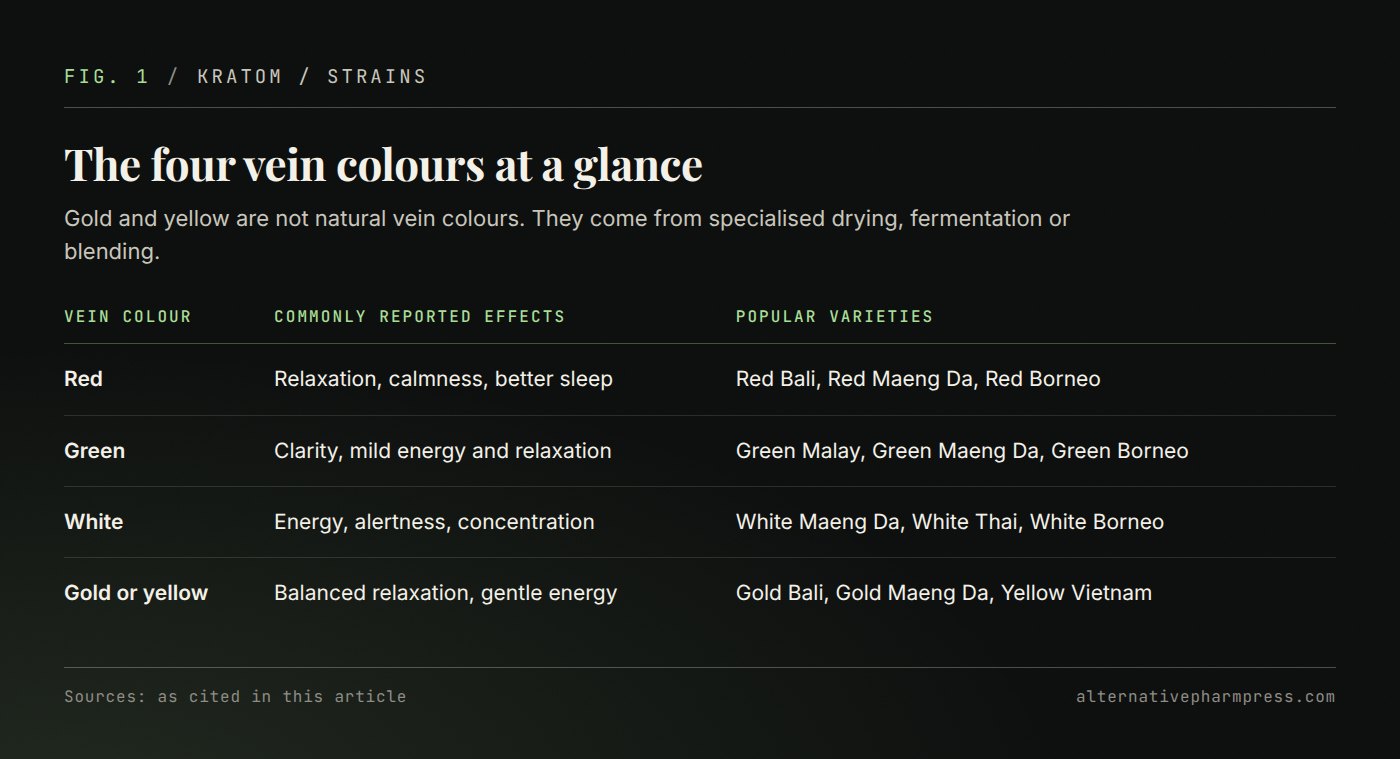
Kratom strains chart: names, claims and lab data
The table below sets common strain names against what sellers typically say and what published research has actually measured. Seller claims are summarised from common marketing descriptions, not endorsed.
| Strain label | What sellers typically claim | What lab or field data show |
|---|---|---|
| Red vein | Relaxing, calming, for evenings and sleep | No alkaloid difference from green or white in one vendor’s tested products; heat-drying alone can turn green leaf red1,2 |
| Green vein | Balanced, moderate energy, mood | Green-veined Thai leaves held somewhat more mitragynine than red-veined in one 2026 study; retail green matched red and white5,1 |
| White vein | Energising, focus, made from young leaves | Young leaves do have a different alkaloid mix, but no study shows retail white is made from them4,1 |
| Gold or yellow | Extra-dried or fermented blend, “smooth” | We found no published analysis of gold or yellow kratom |
| Maeng Da | Premium, “strongest”, energising | Maeng Da products did not differ in key alkaloids from Bali or Thai products tested side by side; “maeng da” is also simply a popular name for kratom1,6 |
| Bali | Smooth, relaxing, beginner-friendly | Bali is outside kratom’s documented native range; Bali products matched others in one analysis4,1 |
| Borneo | Calming, long-lasting | Borneo is within the native range but spans three countries; no Borneo-specific alkaloid data4 |
| Malay | Long-lasting, balanced | Malaysia controls mitragynine, so “Malay” origin is doubtful; one red and one green Malaysian sample differed sharply7,4 |
| Thai | Stimulating, strong | Thai leaf mitragynine ranged from about 0.3% to 4.9% by season and region3 |
| “Enhanced”, “super”, extract-fortified | Stronger than plain leaf | Some products have been found with 7-OH far above natural leaf levels8,9 |
Our detailed comparisons go deeper on each pairing: red vs green kratom, white vs green kratom, red vs white kratom, Maeng Da vs Bali kratom, Borneo vs Bali kratom and Green Malay vs Green Maeng Da.
Red, green and white kratom: what the colours really reflect
Kratom leaves have a central vein that can look white, green or bright red, with pigment stronger on the underside.4 Vendors name products after this vein, but a 2025 post-harvest study noted that Western strain labels are most often based on the colour of the finished powder, not the actual vein or variety.2
Drying changes the colour
In that study, researchers at the University of Florida dried leaves from the same batch at different temperatures. Leaves dried at high temperatures gave a reddish-brown powder, while those dried at 25°C or frozen stayed green. The authors concluded that powder colour mainly signals the post-harvest environment rather than alkaloid composition, and that marketing strains by powder colour can mislead.2
Vein colour is not even fixed on one tree
A 2026 study of eight Thai kratom accessions found one tree carrying leaves with veins ranging from pale green in juvenile leaves to bright red in mature ones, collected at the same time. Mature-leaf alkaloid profiles were largely consistent across accessions despite visibly different vein colours; leaf age mattered more.4 A survey of 745 Thai samples likewise found that geography affected mitragynine but not vein colour.3
One study does report a colour gap in fresh leaf: green-veined Thai leaves contained more mitragynine than red-veined leaves, while samples from the south had relatively more 7-OH.5 That was fresh, controlled plant material, not retail powder, where drying and blending can override vein differences.
What users report about each colour
The only peer-reviewed survey built around strain colours asked 644 current users, most of them customers of one US vendor, to rate the colours they used on 39 effect scales. Only six scales differed between colours: concentration, energy, stimulation, constipation, staying up all night and falling asleep. Red users ranked relaxation or sleep higher as a reason for use; white users ranked concentration and sociability higher; green users ranked mood higher.1
The same vendor’s red, green and white products were tested by an independent lab and did not differ significantly in mitragynine, paynantheine, speciogynine or speciociliatine. The authors suggested reported differences “might be disproportionally influenced by marketing narratives”, while noting that unmeasured minor alkaloids or terpenes could play a part.1
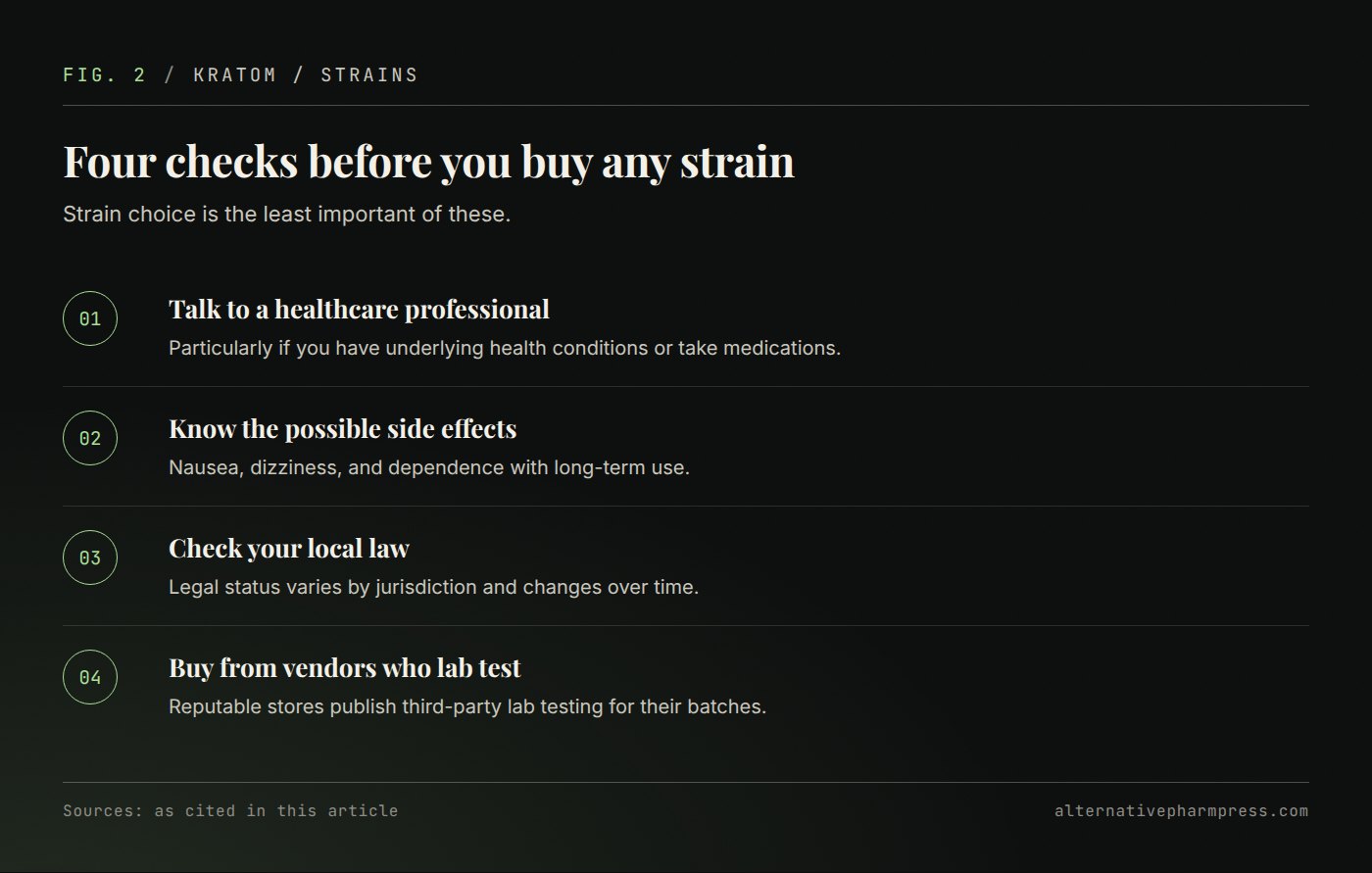
Place names and grades: Maeng Da, Bali, Borneo, Malay and Thai
Kratom’s documented native range covers central and southern Thailand, northern Malaysia, Sumatra, Borneo, the Philippines and New Guinea.4 Some place names fit that range; others do not.
- Maeng Da is a Thai-derived name that sellers use to signal a premium or potent grade. In forensic toxicology it is simply listed as one of kratom’s popular names.6 In the 2023 vendor analysis, White, Red and Green Maeng Da did not differ significantly in key alkaloids from Green Bali, Red Bali or White Thai.1
- Bali is not part of the native range listed above. Many sellers say “Bali” leaf is grown elsewhere in Indonesia, and no certification scheme verifies origin claims.
- Borneo is within the range but is a huge island shared by Indonesia, Malaysia and Brunei, so the name says little about a farm or growing conditions.
- Malay is awkward: Malaysia has listed mitragynine under its Poisons Act 1952 since 2003, controlling import, sale and supply.7 A Malaysian origin for large retail volumes is therefore doubtful.
- Thai leaf varies enormously within Thailand. Across 745 samples, mitragynine ranged from about 0.3% to 4.9% of dry weight depending on season and region.3
Names may track something. A forensic study classified 19 samples from one online distributor by purported country of origin and product line using trace-element fingerprints.10 That shows products under different names can differ in minerals, but it says nothing about alkaloids or effects, and the origins were the seller’s own claims.
Gold, yellow and “enhanced” kratom
Gold and yellow kratom are usually described by sellers as leaf that has been dried longer, fermented or blended. We found no published laboratory analysis of products sold under those names, so any claim about their alkaloid content is unverified.
“Enhanced”, “super” or “extra strength” labels are a bigger concern. They can mean leaf mixed with extract, or fortified with 7-hydroxymitragynine (7-OH), a minor leaf alkaloid that is much more potent at opioid receptors. Toxicologists reported commercial products with 7-OH far above natural leaf levels as early as 2016.8 A 2026 analysis of 38 commercial products found 7-OH and mitragynine pseudoindoxyl in several tablets and capsules, and warned that some lab methods can falsely identify 7-OH.9 Such products are not a strain; they are a different product class. See 7-OH vs traditional kratom and kratom extract vs powder.
What actually changes kratom’s alkaloid content
If the name is a weak guide, these factors are the stronger ones, according to plant studies:
- Season and climate. In one Thai collection, mitragynine peaked at 4.94% in late summer and fell to 0.74% in the rainy season.3
- Growing conditions. In wild Thai kratom, mitragynine ranged from 7.5 to 26.6 mg per gram of dry leaf, linked to light, humidity, soil water, pH and calcium.11
- Leaf age. Mature leaves were dominated by mitragynine (up to 1.19% of dry mass), while juvenile leaves were dominated by speciociliatine.4
- Withering and drying. Withering raised mitragynine by 14% to 65%, and low drying temperatures preserved key alkaloids. 7-OH made up only 0.02% to 0.04% of leaf alkaloid extracts and appeared only in certain seasons.2
- Product-to-product variation. US commercial products shared the same 12 to 13 alkaloids, dominated by mitragynine, but other alkaloids varied from product to product.12 Powders bought online in central Europe averaged roughly 1.4% to 1.8% mitragynine.13
Retail leaf, though, is more uniform than the strain catalogue suggests. When researchers analysed 341 products used by US consumers, they were mostly whole leaf with similar alkaloid composition.14 Our explainer on how kratom is processed covers drying and grinding.
Safety is the same whatever the strain
Because every strain is the same plant, the risks are shared: dependence and withdrawal, rare liver injury, drug interactions and contamination with microbes or heavy metals.15 A “relaxing” red is not a safer choice, and a “clean” white is not a lighter one. The variables that matter for safety are how much mitragynine and 7-OH a batch contains, how often it is used, and what else it is combined with.
Read our guides to kratom and liver injury, kratom drug interactions and kratom tolerance. Strain names also make no difference to drug testing.
How to choose by COA instead of strain name
A batch-specific certificate of analysis says more about a product than any strain label. Our guide to reading a kratom lab report walks through one line by line. Check that:
- The batch matches. The lot number on the COA matches the pack, with a recent test date and a named, contactable independent lab.
- Mitragynine is given as a number. Plain leaf in Thai field studies ranged from about 0.3% to 4.9% of dry weight.3 A “leaf” figure far above that suggests extract or fortification.
- 7-OH is reported. Look for a figure, or “below LOQ” with the limit stated, from a method that confirms identity.9
- Each strain has its own COA. One report reused across a seller’s red, green and white lines tells you nothing about any of them.
- Contaminants are tested. Numeric heavy-metal results and microbial tests, including Salmonella.
See also kratom COA red flags and our kratom powder buying guide.
Legal status: the law ignores strain names
No law distinguishes between kratom colours or place names. In the US, kratom leaf and mitragynine are not federally scheduled, and the FDA says kratom cannot lawfully be sold as a dietary supplement or food.15 On 14 October 2026 the DEA published a revised notice of intent to temporarily place 7-OH and mitragynine pseudoindoxyl in Schedule I when a product holds more than 1 mg per gram (or per millilitre), or has a mitragynine-to-7-OH ratio below 100. The order cannot be published before 13 November 2026.16 An “enhanced” strain that crosses that line would be covered whatever its name. Check our state-by-state kratom guide and our 7-OH scheduling explainer.
Frequently asked questions
What are the main kratom strains?
Sellers group kratom strains by vein colour (red, green, white, sometimes gold or yellow) and by place or grade names such as Maeng Da, Bali, Borneo, Malay and Thai. All are leaf from the same species, Mitragyna speciosa. No regulator defines these names, and tested retail products sold under different colours have not differed significantly in key alkaloids.1
Which kratom strain is the strongest?
No strain is consistently strongest. In the one study that tested a vendor’s products, Maeng Da, Bali and Thai products did not differ significantly in mitragynine or other key alkaloids.1 Strength depends on the batch, which varies with season, region, leaf age and drying.3,2 A batch certificate of analysis showing mitragynine and 7-OH content is the only reliable guide.
What is the difference between red, green and white kratom?
Mainly the label and the drying. Powder colour usually reflects post-harvest handling: in one study, heat-drying turned leaves from the same batch reddish while cooler drying kept them green, without matching alkaloid changes.2 Users report red as more relaxing and white as more stimulating, but tested products did not differ in key alkaloids.1
Is Maeng Da a real strain?
It is a real product name, not a recognised botanical variety. Sellers use the Thai-derived term to signal a premium or potent grade, and forensic toxicologists list “maeng da” simply as a popular name for kratom.6 Origin stories vary between vendors. In one analysis, Maeng Da products matched Bali and Thai products for key alkaloids.1
What is gold or yellow kratom?
Sellers usually describe gold or yellow kratom as leaf dried for longer, fermented, or blended from other colours. We found no published laboratory analysis of products sold under these names, so claims about their alkaloid content or effects are unverified. As with any kratom, check a batch certificate of analysis for mitragynine, 7-OH and contaminant results.
Do kratom strains affect drug tests or legality?
No. Drug tests look for mitragynine and related alkaloids, not strain names, and laws apply to kratom or specific alkaloids rather than colours. The DEA’s October 2026 notice turns on measured 7-OH and mitragynine pseudoindoxyl content, so an “enhanced” product above the threshold would be covered whatever it is called.16
Which kratom strain is strongest?
There’s no reliable answer by color or name. Alkaloid content varies more between batches than strains, so the batch lab report is the better guide. Extracts and 7-OH products are much stronger than any leaf strain.
Sources
- Huisman G, Menke M, Grundmann O, Schreiber R, Mason N. Examining the Psychoactive Differences between Kratom Strains. Int J Environ Res Public Health. 2023;20(14):6425. DOI: 10.3390/ijerph20146425. PMID: 37510657. pubmed.ncbi.nlm.nih.gov
- Zhang M, Lyndon A, Kanumuri SRR, Sharma A, Pearson BJ, McCurdy CR, Chen J. Alkaloid biosynthesis in medicinal crop kratom (Mitragyna speciosa) varies with postharvest, genetic, and seasonal factors. Front Plant Sci. 2025;16:1653916. DOI: 10.3389/fpls.2025.1653916. PMID: 41090093. pubmed.ncbi.nlm.nih.gov
- Sengnon N, Vonghirundecha P, Chaichan W, Juengwatanatrakul T, Onthong J, Kitprasong P, et al. Seasonal and Geographic Variation in Alkaloid Content of Kratom (Mitragyna speciosa (Korth.) Havil.) from Thailand. Plants (Basel). 2023;12(4):949. DOI: 10.3390/plants12040949. PMID: 36840297. pubmed.ncbi.nlm.nih.gov
- Ransden KE, Ramachandria P, Laforest LC, Kanumuri SRR, Sharma A, McCurdy CR, Nadakuduti SS. Comparative analysis of monoterpene indole alkaloid composition and genotypic variation in Thai Mitragyna speciosa. Front Plant Sci. 2026;17:1821609. DOI: 10.3389/fpls.2026.1821609. PMID: 42158609. pubmed.ncbi.nlm.nih.gov
- Krongrawa W, Ponphaiboon J, Koedruen J, Samran C, Limmatvapirat S, Limmatvapirat C. Effects of Botanical Variation, Plant Part, and Extraction Technique on Mitragynine and 7-Hydroxymitragynine in Kratom (Mitragyna speciosa) Extracts Quantified by a Validated HPLC-DAD Method. Molecules. 2026;31(13):2241. DOI: 10.3390/molecules31132241. PMID: 42451610. pubmed.ncbi.nlm.nih.gov
- Papsun DM, Chan-Hosokawa A, Friederich L, Brower J, Graf K, Logan B. The Trouble With Kratom: Analytical and Interpretative Issues Involving Mitragynine. J Anal Toxicol. 2019;43(8):615-629. DOI: 10.1093/jat/bkz064. PMID: 31424079. pubmed.ncbi.nlm.nih.gov
- Malay Mail. Home minister: proposed industrialisation of cannabis, ketum in Malaysia needs control mechanism. 6 October 2022. malaymail.com
- Lydecker AG, Sharma A, McCurdy CR, Avery BA, Babu KM, Boyer EW. Suspected Adulteration of Commercial Kratom Products with 7-Hydroxymitragynine. J Med Toxicol. 2016;12(4):341-349. DOI: 10.1007/s13181-016-0588-y. PMID: 27752985. pubmed.ncbi.nlm.nih.gov
- Sheehan D, Li Y, Meckler E, Upton R, Zhang M. Avoiding False Identification of 7-Hydroxymitragynine in Kratom Products Using a Multicriteria LC-MS Confirmation. J Am Soc Mass Spectrom. 2026;37(5):1303-1312. DOI: 10.1021/jasms.6c00088. PMID: 41989479. pubmed.ncbi.nlm.nih.gov
- Braley C, Hondrogiannis EM. Differentiation of Commercially Available Kratom by Purported Country of Origin using Inductively Coupled Plasma-Mass Spectrometry. J Forensic Sci. 2020;65(2):428-437. DOI: 10.1111/1556-4029.14201. PMID: 31560807. pubmed.ncbi.nlm.nih.gov
- Leksungnoen N, Andriyas T, Ngernsaengsaruay C, Uthairatsamee S, Racharak P, Sonjaroon W, et al. Variations in mitragynine content in the naturally growing Kratom (Mitragyna speciosa) population of Thailand. Front Plant Sci. 2022;13:1028547. DOI: 10.3389/fpls.2022.1028547. PMID: 36388525. pubmed.ncbi.nlm.nih.gov
- Manwill PK, Flores-Bocanegra L, Khin M, Raja HA, Cech NB, Oberlies NH, Todd DA. Kratom (Mitragyna speciosa) Validation: Quantitative Analysis of Indole and Oxindole Alkaloids Reveals Chemotypes of Plants and Products. Planta Med. 2022;88(9-10):838-857. DOI: 10.1055/a-1795-5876. PMID: 35468648. pubmed.ncbi.nlm.nih.gov
- Balázs O, Kárász D, Ashraf AR, Domián BM, Fittler AT, Csabai D, et al. Evaluation of the unregulated online kratom market in two east-central European countries: test purchase and analysis of potential toxicological consequences. Harm Reduct J. 2025;23:10. DOI: 10.1186/s12954-025-01363-0. PMID: 41382258. pubmed.ncbi.nlm.nih.gov
- Sharma A, Smith KE, Kuntz MA, Berthold EC, Elashkar OI, Guadagnoli N, et al. Chemical Analysis and Alkaloid Intake for Kratom Products Available in the United States. Drug Test Anal. 2025;17(10):1974-1984. DOI: 10.1002/dta.3906. PMID: 40377101. pubmed.ncbi.nlm.nih.gov
- US Food and Drug Administration. FDA and Kratom. FDA Public Health Focus; content current as of 2 December 2025. fda.gov
- Drug Enforcement Administration. Schedules of Controlled Substances: Temporary Placement of 7-Hydroxymitragynine and Mitragynine Pseudoindoxyl Above a Specified Threshold in Schedule I (notice of intent). Federal Register. 14 October 2026;91 FR 65370. Document 2026-20943. Docket DEA-1570. federalregister.gov
This article is for educational purposes only and is not medical or legal advice. Products discussed here are not intended to diagnose, treat, cure or prevent any disease. Laws vary by location and change often, so verify the rules that apply where you are. Always talk to a licensed healthcare provider before use, especially if you are under 21, pregnant or nursing, taking medication, or managing a health condition.