
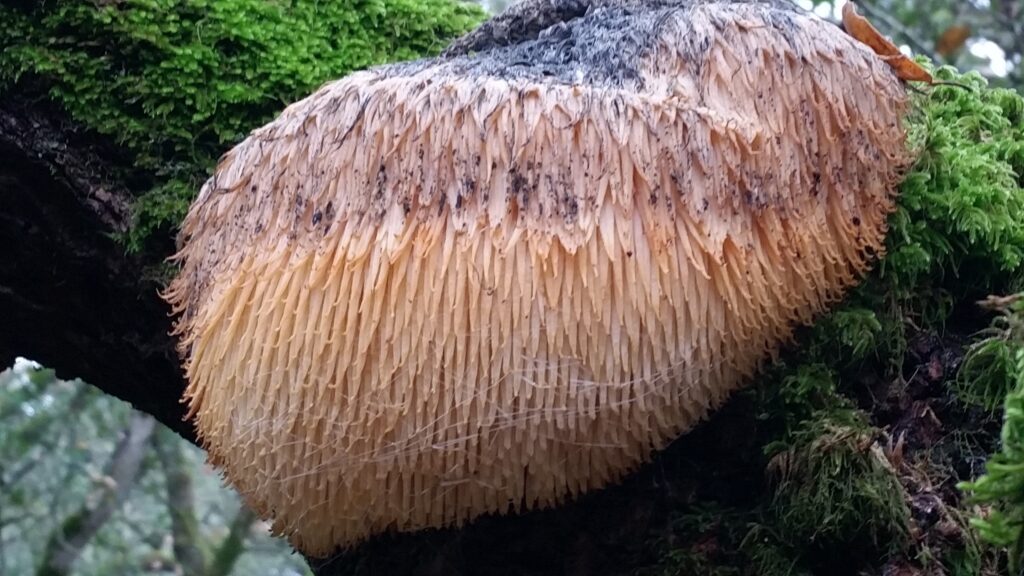
The evidence for lion’s mane benefits on cognition is small and mixed. Seven controlled human trials have tested it on memory or thinking. Positive results come mostly from older adults with existing memory complaints taking 1 to 3 grams a day for 8 to 16 weeks. Trials in healthy young adults have largely found nothing.
Lion’s mane (Hericium erinaceus) is one of the best-selling functional mushrooms, and 2026 added a new peer-reviewed trial to a thin literature. Sales have grown far faster than the research, and many products are not what the label implies.
Below we cover each lion’s mane cognition study, the 2026 trial and how to read a label.
At a glance: the lion’s mane cognition studies
| Study | Participants | Daily amount | Length | Main finding |
|---|---|---|---|---|
| Mori 20091 | 30 aged 50–80 with mild cognitive impairment | 3 g fruiting body | 16 weeks | Better than placebo; faded after stopping |
| Saitsu 20192,8 | 31 healthy, over 50 | 3.2 g fruiting body | 12 weeks | MMSE improved; two other tests did not |
| Li 20203 | 49 with mild Alzheimer’s disease | About 1 g mycelium | 49 weeks | No difference on main cognitive scales |
| Grozier 20228 | 24 college-age | 10 g in muffins | 4 weeks | No effect |
| Docherty 20234 | 41 aged 18–45 | 1.8 g | 1 dose and 28 days | Faster Stroop after one dose; mixed otherwise |
| Surendran 20255 | 18 aged 18–35 | 3 g extract once | 1 dose | No overall effect; one task better, two worse |
| Grant 20266 | 109 aged 40–75 with self-reported difficulty | 2 g mixed | 8 weeks | Modest gains in attention, sleep and mood ratings |
What lion’s mane is, and what is in it
Hericium erinaceus is a white, shaggy mushroom that grows on hardwood and has long been eaten in East Asia. Two compound families drive the research interest: hericenones, found in the fruiting body (the mushroom itself), and erinacines, found mainly in the mycelium, the root-like network the fungus grows through.8 In cell and animal studies both stimulate nerve growth factor, the basis for the cognition claims. That has not been shown to translate into clinical benefit in people.
It also contains beta-glucans, polysaccharides whose content is one of the more useful numbers on a label.
Lion’s mane cognition studies: what each trial found
Older adults and memory complaints
Mori and colleagues, 2009. Thirty Japanese adults aged 50 to 80 with mild cognitive impairment took 3 g a day of dry mushroom powder in tablets, or placebo, for 16 weeks. Scores on a scale based on the Revised Hasegawa Dementia Scale were significantly higher than placebo at weeks 8, 12 and 16, then fell after intake stopped.1 It is still the most cited trial, with 15 people per group.
Saitsu and colleagues, 2019. In this 12-week double-blind trial, 31 adults over 50 took fruiting body powder or placebo. Mini Mental State Examination (MMSE) scores improved; a visual retention test and a verbal learning test did not.2 The lion’s mane group started with higher scores and the placebo group also improved, so practice effects cannot be ruled out.8
Li and colleagues, 2020. The longest trial gave erinacine A-enriched mycelium to people with probable mild Alzheimer’s disease. Of 49 randomised, 41 completed 49 weeks. MMSE rose within the treatment group, but differences between groups on the main cognitive scales were not significant; a daily-living score favoured treatment.3 Several authors worked for the manufacturer.
Healthy young adults
Grozier and colleagues, 2022. Twenty-four college-age adults ate muffins with 10 g a day of extract for four weeks, with no effect on Stroop or mental arithmetic.8
Docherty and colleagues, 2023. Forty-one adults aged 18 to 45 took 1.8 g a day or placebo. An hour after one dose, Stroop responses were faster (p = 0.005). After 28 days, lower subjective stress narrowly missed significance (p = 0.051).4 Across roughly 20 outcomes there were also null and negative results, including worse delayed word recall than placebo.8
Surendran and colleagues, 2025. In a crossover trial, 18 adults aged 18 to 35 drank 3 g of a 10:1 fruiting body extract or a matched control. Overall cognition and mood did not change at 90 minutes. Pegboard dexterity was better, but Flanker task performance was worse than control.5 Two authors worked for a drinks firm that uses lion’s mane.
New in 2026: the largest trial so far
The newest lion’s mane cognition study was posted as a preprint in April 2026 and accepted by Frontiers in Nutrition on 11 October 2026. Adults aged 40 to 75 with self-reported cognitive difficulty took 2 g a day of fruiting body and mycelial biomass, or placebo, for eight weeks, with remote computer testing. Among 109 people analysed, the authors reported modestly better visual attention and working memory on one task, plus better ratings of sleep, morning restedness and mood (p < 0.05). No adverse events were reported on lion’s mane.6
Caveats: an ingredient supplier funded the trial and its staff were co-authors; the registry entry had listed a planned 150 participants over 14 weeks;8 and the mixed product cannot show which part of the fungus matters.
What the lion’s mane research adds up to
A 2025 systematic review found only five randomised controlled trials and three pilot trials among 26 studies, called the evidence heterogeneous and limited, and noted that side effects often went unreported.7 The Alzheimer’s Drug Discovery Foundation concluded that cognitive effects are mixed and that no dose has been established for any use.8
- Who might benefit. Better results come from middle-aged and older people with complaints; young, healthy volunteers show little.
- Small trials, many tests. Most enrolled fewer than 50 people, so a few chance positives are expected.
- Different products. Powder, 10:1 extract and enriched mycelium are not interchangeable.
- Funding. Several recent trials involved manufacturers.
Nothing here supports treating lion’s mane as a therapy for dementia or any neurological disease.
Other claimed lion’s mane benefits: mood, sleep and nerves
A four-week 2010 trial in 30 women using lion’s mane cookies found depression scores improved from baseline, but not compared with placebo, and sleep quality did not improve.8 A 2019 study in 77 overweight adults reported better mood and sleep alongside a diet, with no placebo group.8 The 2026 trial’s ratings are the best controlled data so far, and they were secondary, self-reported outcomes.6 Claims about nerve repair or brain injury rest on cell and animal research; we found no controlled human trials.
Why the lion’s mane market grew faster than the evidence
A September 2026 industry report valued the lion’s mane supplement market at about US$503 million in 2025, up from US$319 million in 2022, with a projection of about US$1.63 billion by 2035. Cognitive health products made up about 38% of revenue.10 An earlier version of this article described 38% as lion’s mane’s share of all mushroom species revenue; it is the cognition share of lion’s mane sales.
When fruiting body supply runs short, cheaper mycelium grown on grain fills the gap. Our look at the functional mushroom boom and its label problems covers the same pattern across species.
Fruiting body, mycelium on grain, and the label problem
- Fruiting body extract. Made from the mushroom itself, often sold as a ratio such as 8:1 or 10:1, ideally with a beta-glucan percentage.
- Mycelium on grain. Grown on rice or oats, then dried and milled whole. In a 2016 analysis, most grain starch stayed intact, and two mycelium-on-grain blends held about 1 to 3 g of beta-glucan per 100 g against 66 to 73 g of starch.9
- Undefined powder. “Polysaccharides” alone, or a milligram figure without the part used, tells you little.
Only one cognition trial reported its erinacine A content.8 In the EU, mycelial extracts are restricted under novel food rules, so supplements there are fruiting body-based.5,8
Two checks help: beta-glucan measured by an enzymatic method rather than “crude polysaccharides”, which include starch,9 and the part used, stated plainly. Our ranking of the best lion’s mane supplement brands of 2026 shows how few disclose both, and signs a brand is genuinely third-party tested explains how to check the lab work.
Amounts used in research
For context, not as a recommendation: trials used 1.8 to 3.2 g a day of fruiting body powder, 3 g of a 10:1 extract once, or about 1 g a day of enriched mycelium.1,3,4,5 Concentrations vary too much to compare grams across products.
Safety in brief
Trials have reported few problems. In the 2020 trial, three people on lion’s mane and one on placebo dropped out with abdominal discomfort, nausea or rash.3 The 2025 review listed stomach upset, headache and allergic reactions.7 Interaction data are lacking, and pregnancy is unstudied. Our article on lion’s mane side effects in human trials covers the case reports.
In the US, lion’s mane is a dietary supplement. The FDA does not approve supplements before sale, and a product labelled to treat a disease is regulated as a drug.11
How lion’s mane compares with other brain supplements
For head-to-head comparisons, see bacopa vs lion’s mane, where bacopa has the larger memory trial base, reishi vs lion’s mane and lion’s mane vs cordyceps.
Frequently asked questions
Does lion’s mane improve memory?
The evidence is weak. The strongest signal is a 2009 trial in 30 older adults with mild cognitive impairment, whose scores improved over 16 weeks and fell after stopping. A 2019 trial found gains on one test of three. Trials in healthy young adults have mostly found no memory benefit, and one found worse delayed recall than placebo.
What did the 2026 lion’s mane cognition study find?
In 109 adults aged 40 to 75 with self-reported cognitive difficulty, 2 g a day of fruiting body and mycelial biomass for eight weeks modestly improved visual attention and working memory on one computer task, and improved self-rated sleep and mood. An ingredient supplier funded it, and it used a mixed product.
Fruiting body or mycelium: which is better?
No trial has compared them directly. They contain different compounds: hericenones in the fruiting body, erinacines mainly in the mycelium. Mycelium grown on grain is often mostly starch, with little beta-glucan. A product that names the part used and states a tested beta-glucan percentage is easier to verify.
How long does lion’s mane take to work?
In trials reporting benefits, changes appeared over 8 to 16 weeks in older adults. One study found faster Stroop responses an hour after a single dose, while another single-dose trial found one task better and two worse. In the 2009 trial, gains faded within four weeks of stopping.
Is lion’s mane a treatment for dementia?
No. It is sold as a dietary supplement and no regulator has approved it for cognitive decline or any disease. The only trial in people with mild Alzheimer’s disease found no significant difference from placebo on its main cognitive scales after 49 weeks. Anyone with memory problems should see a doctor, as several causes are treatable.
Does lion’s mane work?
Small human trials suggest modest benefits for memory or mood in some groups, but results are mixed and products vary. It isn’t a proven treatment for any condition.
Sources
- Mori K, Inatomi S, Ouchi K, et al. Improving effects of the mushroom Yamabushitake (Hericium erinaceus) on mild cognitive impairment: a double-blind placebo-controlled clinical trial. Phytother Res. 2009;23(3):367-372. DOI: 10.1002/ptr.2634. PMID: 18844328. pubmed.ncbi.nlm.nih.gov
- Saitsu Y, Nishide A, Kikushima K, et al. Improvement of cognitive functions by oral intake of Hericium erinaceus. Biomed Res. 2019;40(4):125-131. DOI: 10.2220/biomedres.40.125. jstage.jst.go.jp
- Li IC, Chang HH, Lin CH, et al. Prevention of early Alzheimer’s disease by erinacine A-enriched Hericium erinaceus mycelia pilot double-blind placebo-controlled study. Front Aging Neurosci. 2020;12:155. DOI: 10.3389/fnagi.2020.00155. PMID: 32581767. pubmed.ncbi.nlm.nih.gov
- Docherty S, Doughty FL, Smith EF. The acute and chronic effects of lion’s mane mushroom supplementation on cognitive function, stress and mood in young adults: a double-blind, parallel groups, pilot study. Nutrients. 2023;15(22):4842. DOI: 10.3390/nu15224842. PMID: 38004235. pubmed.ncbi.nlm.nih.gov
- Surendran G, Saye J, Binti Mohd Jalil S, et al. Acute effects of a standardised extract of Hericium erinaceus (lion’s mane mushroom) on cognition and mood in healthy younger adults: a double-blind randomised placebo-controlled study. Front Nutr. 2025;12:1405796. DOI: 10.3389/fnut.2025.1405796. frontiersin.org
- Grant A, Daoust J, Farrar S, et al. A randomized, double-blind, placebo-controlled study evaluating the impact of Hericium erinaceus (lion’s mane) on cognitive performance and subjective wellbeing. Front Nutr. 2026;13. DOI: 10.3389/fnut.2026.1904820. frontiersin.org
- Menon A, Jalal A, Arshad Z, et al. Benefits, side effects, and uses of Hericium erinaceus as a supplement: a systematic review. Front Nutr. 2025;12:1641246. DOI: 10.3389/fnut.2025.1641246. frontiersin.org
- Alzheimer’s Drug Discovery Foundation. Cognitive Vitality report: Lion’s mane mushroom. Updated 14 July 2025. alzdiscovery.org
- McCleary BV, Draga A. Measurement of β-glucan in mushrooms and mycelial products. J AOAC Int. 2016;99(2):364-373. DOI: 10.5740/jaoacint.15-0289. doi.org
- Global Market Insights. Lion’s Mane Mushroom Supplements Market report. September 2026. gminsights.com
- US Food and Drug Administration. Questions and Answers on Dietary Supplements. fda.gov
This article is for educational purposes only and is not medical or legal advice. Products discussed here are not intended to diagnose, treat, cure or prevent any disease. Laws vary by location and change often, so verify the rules that apply where you are. Always talk to a licensed healthcare provider before use, especially if you are under 21, pregnant or nursing, taking medication, or managing a health condition.