
Anxiety is among the most common reasons people try CBD. Surveys of CBD users consistently list stress and anxiety near the top, and many people report feeling calmer. But what do controlled human studies show about CBD for anxiety, and how closely do they match the products sold in stores?
This guide reviews the main human research, the doses studied, why retail products often differ, side effects and drug interactions, and how CBD compares with established anxiety treatments.
Key takeaways
- Several small controlled studies found single doses of CBD (often 300–600 mg) reduced anxiety during simulated public speaking.
- A few trials in social anxiety disorder showed benefits; evidence for generalized anxiety disorder and PTSD is limited and mixed.
- Some studies show a bell-shaped dose response: moderate doses helped while lower or higher doses did not.
- Most retail products contain 10–50 mg per serving, far less than many study doses.
- CBD can cause drowsiness, diarrhea and liver enzyme changes and interacts with many medications.
How CBD might affect anxiety
CBD doesn’t strongly activate cannabinoid receptors the way THC does. Instead, research suggests it may act on serotonin 5-HT1A receptors (a target of some anti-anxiety drugs), influence the endocannabinoid system indirectly by affecting how anandamide is broken down, and modulate activity in brain regions involved in fear and threat processing, such as the amygdala. Brain imaging studies have shown changes in these regions after CBD. For background, see CBD meaning.
What human studies show
Public speaking studies
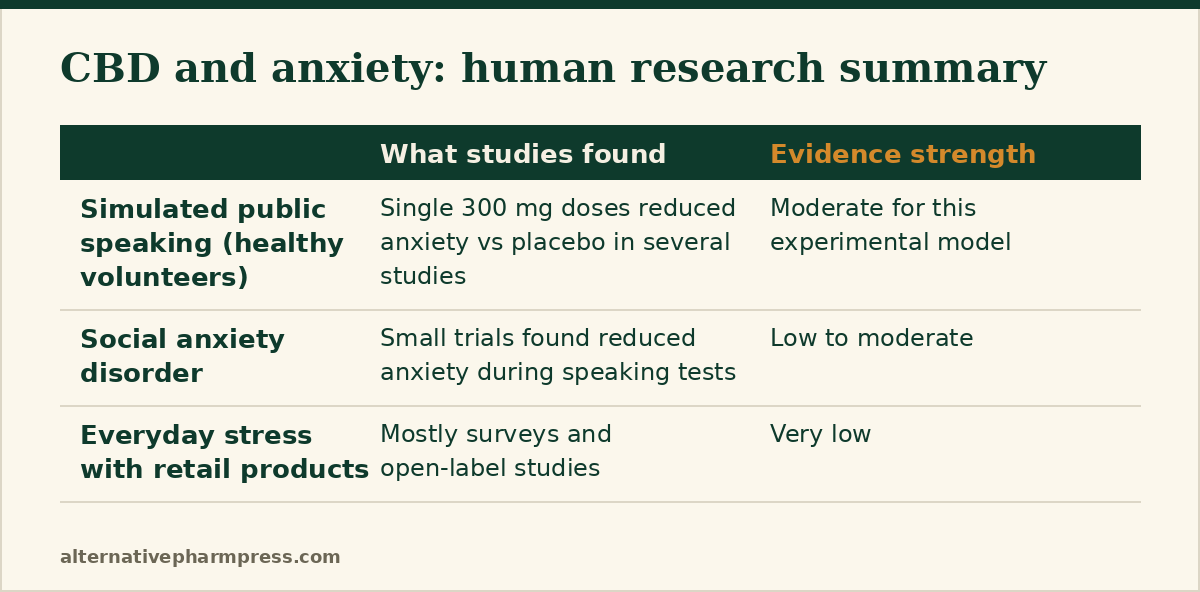
The best-known research uses a simulated public speaking test, a standard way to induce anxiety in a lab. In several Brazilian studies, healthy volunteers who took around 300 mg of CBD before speaking reported less anxiety than those who took placebo. Interestingly, 100 mg and 900 mg doses were less effective in some studies, suggesting a bell-shaped (inverted-U) dose response.
Social anxiety disorder
Small trials in people with social anxiety disorder found that a single 400–600 mg dose of CBD reduced anxiety during speaking tasks, and one Japanese study in teenagers with social anxiety found benefits over four weeks with 300 mg daily. Sample sizes were small.
Generalized anxiety and other conditions
Evidence for generalized anxiety disorder is thinner. Some open-label studies (where everyone knows they’re getting CBD) and case series reported improvements, but these are prone to bias. A few controlled trials have shown mixed results. Research in PTSD includes small studies with varied outcomes.
The dose gap
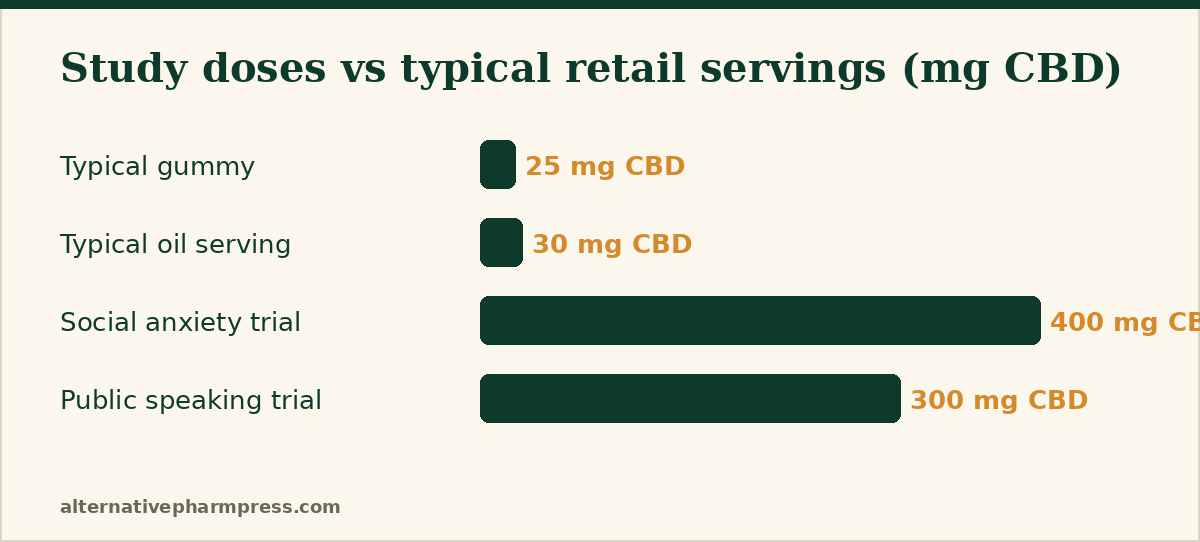
Most studies used pharmaceutical-grade CBD at doses of hundreds of milligrams. Retail gummies and oils typically provide 10–50 mg per serving. That doesn’t mean lower doses can’t help some people, but it does mean most retail use hasn’t been directly tested. Taking hundreds of milligrams daily from retail products would also be expensive and increase the risk of side effects and interactions.
Why personal experiences vary
Many people report feeling calmer on low-dose CBD. Possible explanations include genuine effects at lower doses for some individuals, placebo effects (which are strong for anxiety), the calming ritual of taking something, small amounts of THC in full-spectrum products, and added ingredients like melatonin or L-theanine. Read does CBD get you high? and full-spectrum vs broad-spectrum CBD.
CBD and THC
CBD and THC have very different effects on anxiety. THC can relieve or worsen anxiety depending on dose, while CBD doesn’t produce intoxication. Some research suggests CBD may blunt THC-induced anxiety, but results are mixed. Read THC and anxiety.
Side effects
In clinical studies, CBD has generally been well tolerated, but side effects can include:
- Drowsiness and fatigue.
- Diarrhea and stomach upset.
- Changes in appetite.
- Elevated liver enzymes, especially at high doses or with certain medications.
Drug interactions
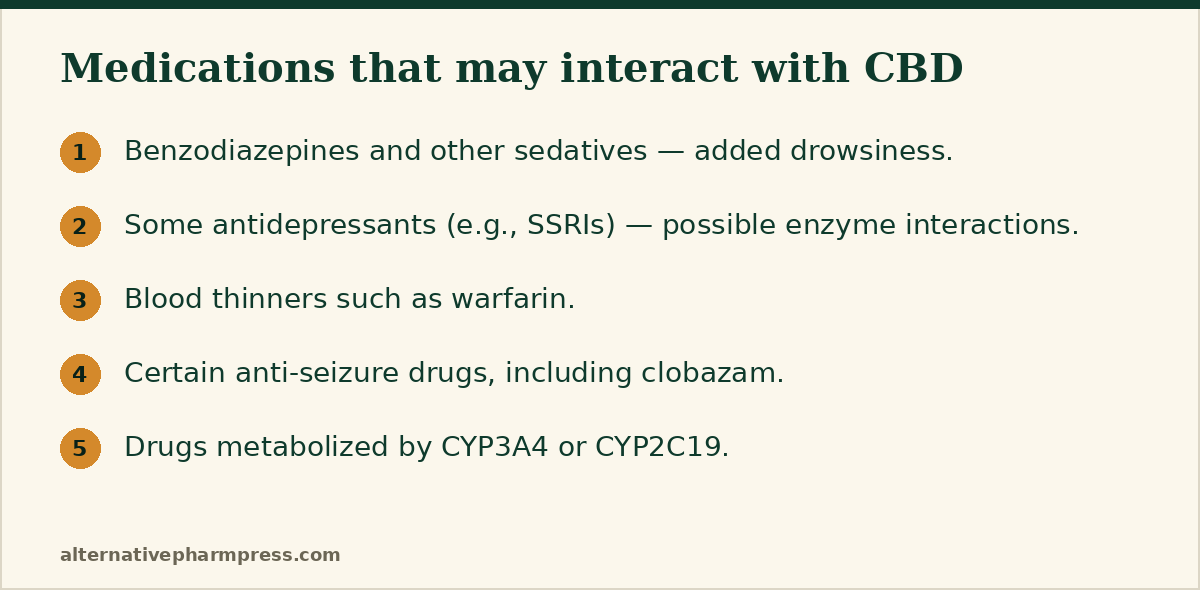
Many people with anxiety take medications such as SSRIs, SNRIs, buspirone or benzodiazepines. CBD can affect how the liver processes some of these. Talk to your prescriber or pharmacist before adding CBD, and don’t stop prescribed medications without guidance. See CBD and blood pressure medication for another example of how interactions work.
CBD vs established anxiety treatments
| Approach | Evidence | Notes |
|---|---|---|
| Cognitive behavioral therapy (CBT) | Strong | First-line for many anxiety disorders |
| SSRIs/SNRIs | Strong | Effective for GAD, social anxiety, panic |
| Exercise | Moderate | Benefits for anxiety symptoms |
| CBD | Low to moderate (specific models) | Mostly short-term lab studies |
CBD may be something people explore, but it isn’t a substitute for proven treatments for anxiety disorders. Read best supplements for anxiety for other supplement evidence.
How people try CBD for anxiety
If you decide to try CBD, a cautious approach might include:
- Talking to your clinician, especially if you take medications.
- Choosing a tested product with a batch-specific COA.
- Starting low and increasing gradually while tracking effects.
- Using it consistently for a few weeks before judging results.
- Tracking anxiety with a simple daily rating.
- Stopping if side effects occur or there’s no benefit.
For product formats, see CBD capsules, CBD gummies vs CBD oil and what to check when buying CBD online.
Situational vs daily use
Some research tested single doses before a stressful event, while other studies used daily dosing. People sometimes use CBD situationally — for example, before a flight or presentation — while others take it daily. If you’re considering situational use, keep in mind that oral CBD takes time to reach peak levels, often one to three hours.
Drug tests
Full-spectrum CBD contains small amounts of THC and can cause positive drug tests with regular use. If you’re tested, choose isolate or broad-spectrum products and check COAs. Read can CBD fail a drug test?.
When to seek professional help
Anxiety that interferes with work, relationships or daily life deserves professional care. Seek help urgently if you experience panic attacks with chest pain, thoughts of self-harm or inability to function. Effective treatments exist, and combining approaches often works best.
What future research needs to answer
Key questions remain: Do lower, retail-level doses work in controlled trials? Does daily CBD reduce anxiety over months, not just hours? Which anxiety disorders respond best? How do full-spectrum products compare with isolate? Large, long-term randomized trials are needed. Until then, CBD remains a promising but unproven option for anxiety outside specific experimental settings.
CBD for sleep problems linked to anxiety
Anxiety and poor sleep often go together. Some people use CBD at night hoping to quiet racing thoughts. Evidence for CBD and sleep is mixed; read CBD for sleep: what human trials found. Cognitive behavioral therapy for insomnia (CBT-I) is a well-supported option for chronic sleep problems.
Cost considerations
At study-level doses, CBD would be expensive. A 300 mg daily dose from a typical retail oil could cost several dollars a day or more. That’s one reason most people use much lower amounts. If you’ve tried a reasonable dose consistently for several weeks without benefit, it may not be worth continuing.
Understanding the bell-shaped dose curve
The inverted-U pattern seen in some CBD anxiety studies means that both too little and too much may be less effective than a moderate dose. This pattern isn’t unique to CBD — it appears with several compounds that act on multiple receptor systems. For consumers, it suggests that simply taking more CBD isn’t guaranteed to work better. It also highlights how much remains unknown: the “right” dose likely varies by person, formulation and type of anxiety, and retail-level doses haven’t been mapped on this curve in rigorous trials.
Reading CBD anxiety claims critically
Marketing often cites “studies show CBD reduces anxiety” without context. When you see such claims, ask: Was the study in humans or animals? Was it placebo-controlled? What dose and product were used? Was it a single dose in a lab or daily use over weeks? Who funded it? A product containing 15 mg of CBD per gummy can’t honestly borrow results from a trial using 300 mg of pharmaceutical-grade CBD. Brands that make careful, evidence-based statements — and avoid promising to treat anxiety disorders — are generally more trustworthy.
FAQ
Does CBD help with anxiety?
Small controlled studies found single doses of around 300–600 mg reduced anxiety in public speaking tests and social anxiety. Evidence for everyday use at retail doses is limited.
How much CBD do studies use for anxiety?
Commonly 300–600 mg in single-dose studies, which is much higher than typical retail servings.
How long does CBD take to work for anxiety?
Oral CBD usually takes one to three hours to reach peak levels. Daily use may take weeks to evaluate.
Can I take CBD with anxiety medication?
CBD can interact with some anxiety medications. Talk to your prescriber or pharmacist first.
Is CBD better than therapy or medication for anxiety?
No. CBT and medications like SSRIs have much stronger evidence. CBD may be explored alongside, not instead of, proven treatments.
Can CBD make anxiety worse?
It’s uncommon, but some people feel restless or experience side effects. Full-spectrum products with THC may increase anxiety in sensitive people.