
Walk down a CBD aisle and you’ll see bottles labeled “CBD oil,” “CBD tincture” and “CBD oil tincture” — often looking identical, with the same glass bottle and dropper. Are they different products, or just different names?
Technically, a CBD tincture and a CBD oil are made differently. In practice, the industry uses the words loosely, and most products labeled “tincture” today are actually oils. This guide explains the real differences and what matters when choosing one.
Key takeaways
- A traditional tincture uses alcohol (or glycerin) as the base; a CBD oil uses a carrier oil such as MCT, hemp seed or olive oil.
- Most “CBD tinctures” sold today are actually oils packaged in dropper bottles.
- Both are typically taken under the tongue (sublingually) for faster onset than edibles.
- Bioavailability differences are modest; consistency and dosing matter more.
- Check the mg of CBD per mL, carrier, spectrum and a batch-matched COA.
The technical difference
Tinctures
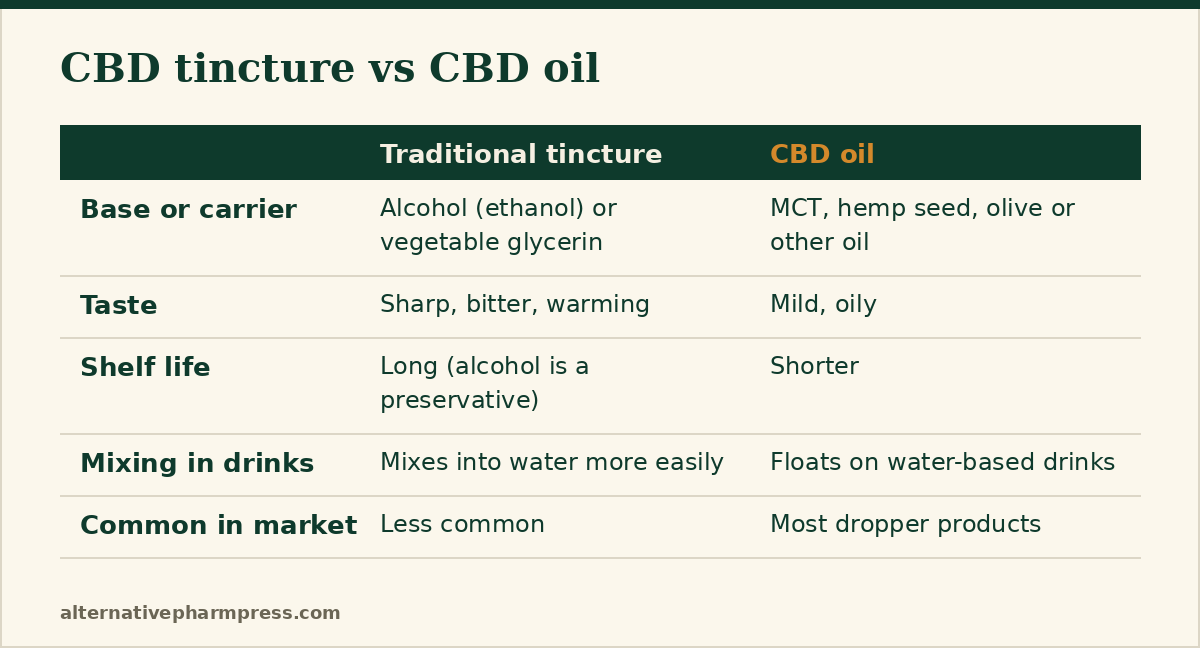
Herbal tinctures have been made for centuries by soaking plant material in alcohol, which extracts active compounds and preserves them. A true CBD tincture either uses alcohol extraction or dissolves CBD extract in alcohol. Glycerin-based tinctures are an alcohol-free alternative with a sweeter taste.
CBD oils
CBD oils dissolve CBD extract in a fatty carrier oil. MCT oil (medium-chain triglycerides, usually from coconut) is the most common because it’s thin, tasteless and stable. Hemp seed oil and olive oil are also used. Because CBD is fat-soluble, oil carriers suit it well.
Why the terms got mixed up
As the CBD market grew, brands used “tincture” to describe any dropper bottle taken under the tongue — because that’s how herbal tinctures were traditionally used. Today, the label “tincture” often describes the format (dropper bottle) rather than the base. Read the ingredient list to see what you’re actually buying.
Does one absorb better than the other?
Taking CBD sublingually — holding drops under the tongue for 60–90 seconds — lets some CBD absorb through the mucous membranes, bypassing part of the liver’s “first-pass” metabolism. Whatever you don’t absorb is swallowed and processed like an edible.
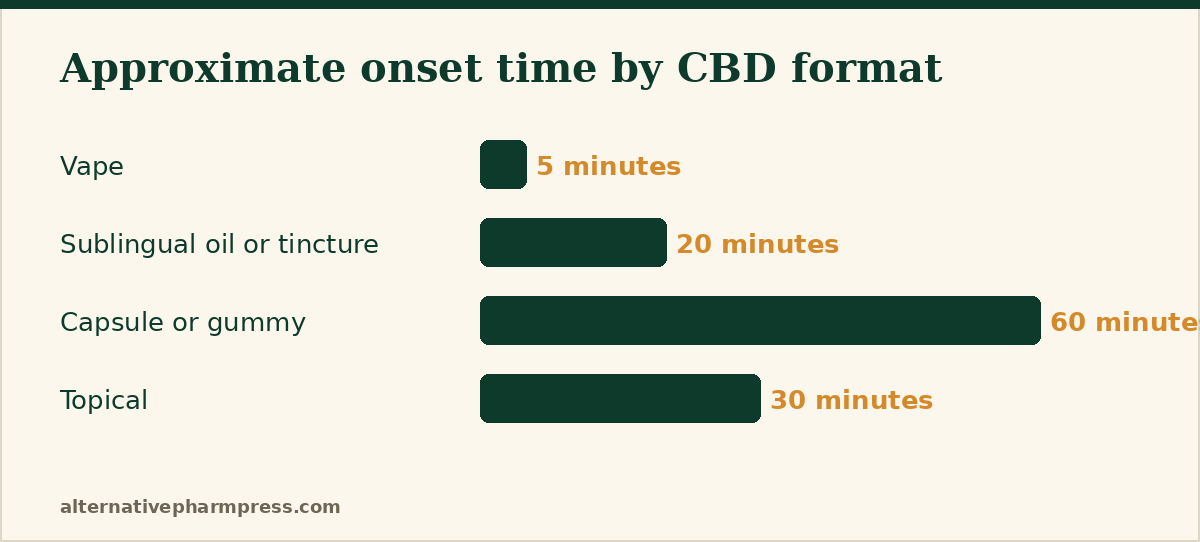
Onset figures are approximate and vary by person and product.
- Alcohol tinctures may absorb slightly faster sublingually, but the burning taste makes it hard to hold them under the tongue for long.
- MCT oil may help CBD absorb when swallowed, because fats aid cannabinoid uptake.
- Overall oral bioavailability of CBD is low (often estimated in the single digits to around 20% when swallowed), and differences between carriers are small compared with differences in dose and consistency.
Taking CBD with a meal containing fat can increase absorption substantially when swallowed. For more on formats, see CBD gummies vs CBD oil.
How to dose with a dropper
Most dropper bottles hold 30 mL, and a full dropper is about 1 mL. To work out how much CBD is in each dropper:
CBD per mL = total CBD in bottle (mg) ÷ bottle size (mL)
| Bottle strength | Bottle size | CBD per full dropper (1 mL) | CBD per drop (about 0.05 mL) |
|---|---|---|---|
| 300 mg | 30 mL | 10 mg | about 0.5 mg |
| 600 mg | 30 mL | 20 mg | about 1 mg |
| 1,000 mg | 30 mL | about 33 mg | about 1.7 mg |
| 1,500 mg | 30 mL | 50 mg | about 2.5 mg |
| 3,000 mg | 30 mL | 100 mg | about 5 mg |
Droppers rarely fill completely in one squeeze, so many people use graduated droppers marked in 0.25 mL increments. Start low, increase gradually and keep a simple log. Our CBD meaning guide covers general dosing principles.
Full-spectrum, broad-spectrum or isolate?
Both tinctures and oils come in three main types:
- Full-spectrum: CBD plus other cannabinoids, terpenes and up to 0.3% THC.
- Broad-spectrum: similar, with THC removed.
- Isolate: pure CBD only.
Full-spectrum products can contain enough THC to cause a positive drug test with regular use. See full-spectrum vs broad-spectrum CBD and can CBD fail a drug test?.
Quality checklist
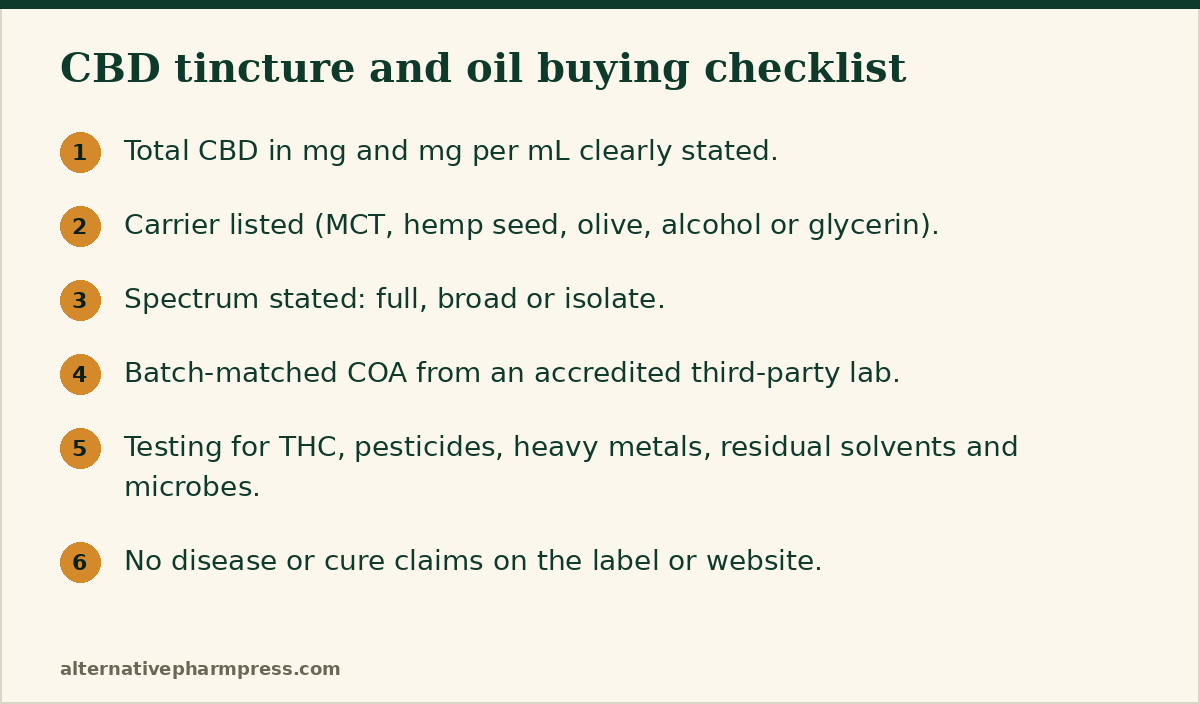
Independent testing has repeatedly found CBD products with more or less CBD than labeled, and some with undeclared THC. A COA is your best protection. Learn more in what to check when buying CBD online, and see vetted options in best CBD brands.
Also note the difference between CBD oil and hemp seed oil: hemp seed oil contains little or no CBD. See CBD oil vs hemp oil.
Storage and shelf life
- Store bottles in a cool, dark place with the cap tightly closed.
- Alcohol tinctures keep longer; oils can go rancid over time (watch for off smells).
- Most products carry a 12–24 month shelf life unopened.
- Don’t leave bottles in hot cars or direct sunlight, which degrade cannabinoids.
Safety and interactions
CBD can interact with medications processed by liver enzymes CYP3A4 and CYP2C19, including some blood thinners, anti-seizure drugs and blood pressure medicines. Read CBD and blood pressure medication. Alcohol-based tinctures may not suit people avoiding alcohol for medical, religious or recovery reasons.
Which should you choose?
- Choose an oil if you want a mild taste, are avoiding alcohol, or plan to take it with food.
- Choose an alcohol tincture if you want a long shelf life or plan to mix it into water-based drinks.
- Choose a glycerin tincture if you want alcohol-free and sweeter.
For most people, the carrier matters far less than choosing a tested product with a clear dose.
How to take a CBD oil or tincture properly
- Shake the bottle. CBD and other compounds can settle.
- Measure your dose with a graduated dropper.
- Place it under your tongue and hold for 60–90 seconds before swallowing.
- Avoid eating or drinking for a few minutes afterward to maximize sublingual absorption.
- Be consistent. Taking CBD at the same time each day makes it easier to judge effects.
If you dislike the taste, flavored oils or mixing into a small amount of food can help, though swallowing reduces sublingual absorption.
Common carrier oils compared
The carrier in a CBD oil affects taste, texture, shelf life and suitability for people with allergies or dietary preferences:
- MCT oil — Derived mostly from coconut or palm kernel. Thin, nearly tasteless, resistant to oxidation and the industry standard. A small number of people experience stomach upset at larger amounts.
- Hemp seed oil — Nutty, green flavor and rich in omega fatty acids, but it oxidizes faster and has a shorter shelf life.
- Olive oil — Familiar taste and widely tolerated, though thicker and more noticeable in flavor.
- Avocado or grapeseed oil — Less common, mild flavors, used by some premium brands.
- Sunflower lecithin — Sometimes added as an emulsifier; people with sunflower allergies should check.
If you have a tree nut, coconut or seed allergy, read the full ingredient list before buying, since “natural flavors” and blends can hide sources.
Flavored vs unflavored products
Unflavored full-spectrum oils taste earthy, grassy and slightly bitter — the taste of hemp extract itself. Flavored versions add natural or artificial flavors, sweeteners or essential oils like peppermint. Flavoring makes daily use more pleasant but adds ingredients; check that sweeteners or essential oils don’t cause you problems. Some people prefer unflavored oils so they can mix them into food or drinks without clashing flavors.
Water-soluble CBD: a third option
You may also see “water-soluble” or “nano” CBD. These products use emulsifiers to break CBD into tiny droplets that disperse in water. Manufacturers claim faster onset and better absorption. Some early pharmacokinetic studies support faster absorption, but quality varies, and long-term data on the emulsifiers is limited. They’re mainly useful for mixing into drinks.
FAQ
Is CBD tincture the same as CBD oil?
Not technically. Tinctures use alcohol or glycerin as a base, while CBD oils use carrier oils. However, many products labeled “tincture” are actually oils.
Which absorbs faster, CBD tincture or oil?
Differences are small. Both absorb partly under the tongue when held there for a minute or more. Taking either with a fatty meal improves absorption when swallowed.
How many mg of CBD are in a dropper?
Divide the bottle’s total CBD by its volume in mL. For a 1,000 mg, 30 mL bottle, a full 1 mL dropper contains about 33 mg.
How long does a CBD tincture take to work?
Sublingual use often takes 15–45 minutes; if swallowed, it can take an hour or more.
Do CBD tinctures expire?
Yes. Most have a 12–24 month shelf life. Oils can go rancid; alcohol tinctures generally last longer.
Can I put CBD oil in my coffee or smoothie?
Yes, but oil floats on water-based drinks and much of it may stick to the cup. Mixing into something with fat, like milk or a smoothie with nut butter, works better. Alcohol tinctures and water-soluble products mix more easily.
What strength should I buy?
Many beginners start with a 300–600 mg bottle (10–20 mg per full dropper), which makes small doses easy to measure. Higher strengths are more cost-effective once you know what dose suits you.
Can you bring CBD oil on a plane?
TSA allows hemp-derived CBD products that meet federal law, and liquids must follow the 3.4 oz carry-on rule. From 11 December 2026, products over 0.4 mg total THC per container may no longer qualify as hemp, and destination laws still apply.
Do you need a prescription for CBD oil?
Not for hemp-derived CBD products sold as consumer goods in most states. The only prescription CBD medicine is Epidiolex, which is FDA-approved for certain seizure disorders.