
“CBD” is printed on gummies, oils, coffee, lotions, dog treats and even mattresses. But a surprising number of people who buy it aren’t sure what the letters stand for or what the compound actually does. This guide explains the CBD meaning in plain language — what CBD is, where it comes from, how it works, what the evidence supports and how to avoid the most common buying mistakes.
Key takeaways
- CBD stands for cannabidiol, one of more than 100 cannabinoids found in the cannabis plant.
- CBD is not intoxicating — it does not produce a “high” like THC.
- It is FDA-approved in one prescription drug (Epidiolex) for certain seizure disorders; most other uses are not proven.
- CBD products are loosely regulated, so third-party lab tests are essential.
- CBD can interact with medications, especially those processed by the liver.
What does CBD stand for?
CBD is short for cannabidiol (pronounced can-uh-bih-DYE-ol). It is a cannabinoid — a class of compounds produced mainly by the cannabis plant. Cannabis produces more than 100 cannabinoids, but two dominate: THC (tetrahydrocannabinol), which causes intoxication, and CBD, which does not.
In the plant, CBD is mostly made as CBDA (cannabidiolic acid), which converts to CBD when heated or dried over time. You can read more about the raw acid form in our CBDA explainer.
CBD vs THC vs hemp: clearing up the confusion
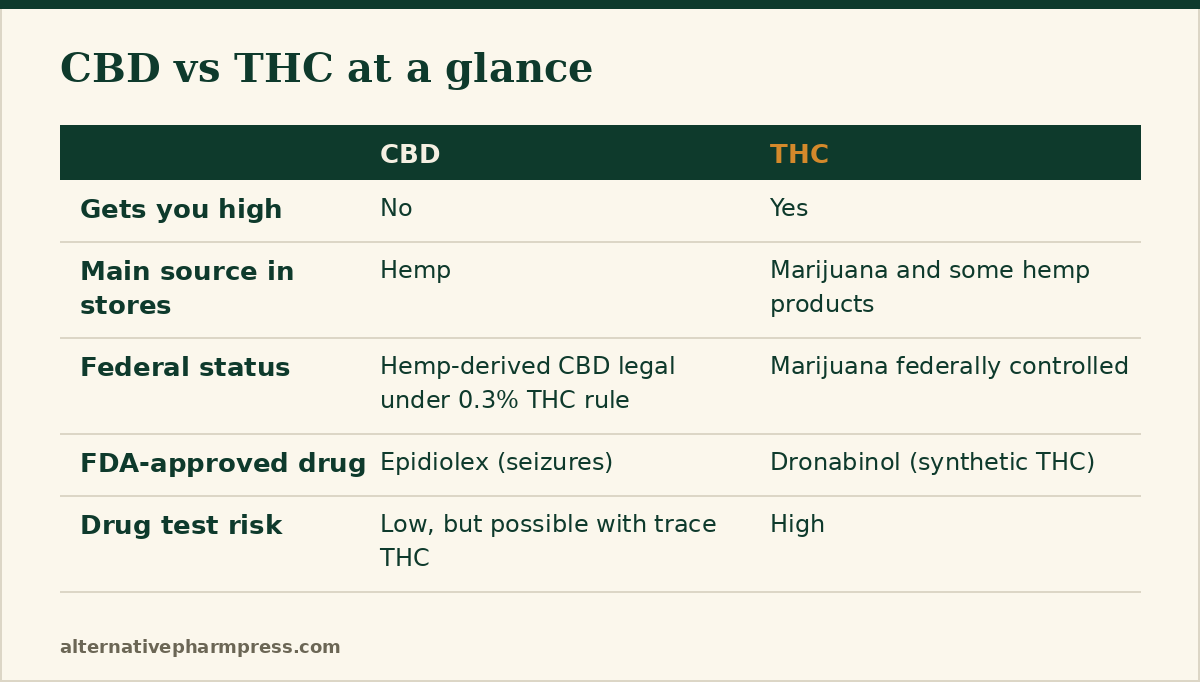
- CBD vs THC: Both are cannabinoids, but THC strongly activates the brain’s CB1 receptor and causes a high. CBD does not, and may even blunt some of THC’s effects.
- Hemp vs marijuana: Botanically, both are Cannabis sativa. Under US law, “hemp” is cannabis with no more than 0.3% delta-9 THC by dry weight. Most CBD sold in stores comes from hemp.
- Hemp oil vs CBD oil: “Hemp seed oil” is pressed from seeds and contains little or no CBD. True CBD oil is extracted from flowers and leaves. See CBD oil vs hemp oil for how to tell them apart.
Our broader comparison of CBD vs hemp vs THC covers the legal side in more detail.
How CBD works in the body
Your body has an endocannabinoid system (ECS) — a signaling network involved in pain, mood, sleep, appetite, inflammation and immune function. It includes receptors (CB1 and CB2), the body’s own cannabinoids (such as anandamide) and enzymes that build and break them down.
CBD interacts with this system in indirect and complex ways:
- It has low direct affinity for CB1 and CB2 receptors, which is why it doesn’t cause a high.
- It may slow the breakdown of anandamide, nudging the body’s own cannabinoid signaling.
- It acts on non-cannabinoid targets, including serotonin 5-HT1A receptors, TRPV1 (involved in pain and temperature sensing) and GPR55.
These many targets help explain why CBD is studied for so many conditions — and why results are often modest or mixed.
What CBD is proven to do — and what it isn’t
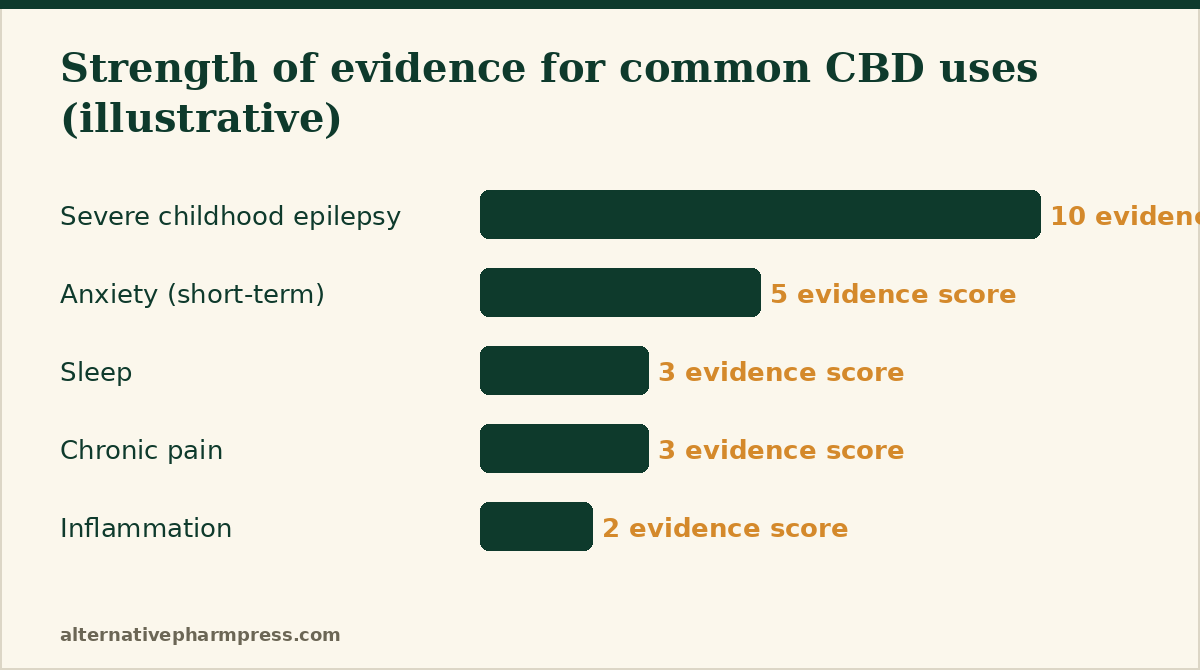
The chart is an illustrative ranking based on the overall quality of published human studies, not a precise score.
Strong evidence: certain seizure disorders
The FDA approved Epidiolex, a purified CBD medicine, in 2018 for seizures associated with Lennox-Gastaut syndrome and Dravet syndrome, later adding tuberous sclerosis complex. These approvals followed rigorous randomized controlled trials. Doses used are far higher than in typical consumer products.
Some evidence: anxiety
Small human studies suggest single doses of CBD (often 300–600 mg) can reduce anxiety in experimental settings such as simulated public speaking. Evidence for everyday, long-term use is limited. See our roundup of supplements for anxiety.
Limited or mixed evidence: sleep, pain, inflammation
Sleep studies show mixed results, and some benefits may reflect reduced anxiety. Pain research is promising in animals but inconsistent in humans, with many studies combining CBD and THC. Read CBD for sleep: what the human trials found and CBN vs CBD for related comparisons.
Not supported: cures and disease claims
CBD has not been shown to cure cancer, Alzheimer’s, diabetes or other diseases. The FDA has repeatedly warned companies making such claims.
Types of CBD products
| Type | What it contains | Who it suits |
|---|---|---|
| Full-spectrum | CBD plus other cannabinoids, terpenes and up to 0.3% THC | People who want the “entourage effect” and aren’t drug-tested |
| Broad-spectrum | CBD plus other compounds, THC removed | People who want more than isolate but avoid THC |
| Isolate | Pure CBD only | People who want zero THC or precise dosing |
Learn more in full-spectrum vs broad-spectrum CBD and CBD isolate vs full spectrum.
Common formats include oils and tinctures (taken under the tongue), gummies and edibles, capsules, topicals, vapes and beverages. Onset and bioavailability vary a lot between formats — see CBD gummies vs CBD oil.
Is CBD safe?
CBD is generally well tolerated, but it is not risk-free:
- Side effects: drowsiness, diarrhoea, changes in appetite, fatigue.
- Liver: high doses in clinical trials caused elevated liver enzymes in some patients.
- Drug interactions: CBD inhibits liver enzymes (CYP3A4 and CYP2C19) that process many medications, including blood thinners, some anti-seizure drugs and certain blood pressure medications. Read CBD and blood pressure medication.
- Drug tests: full-spectrum products can contain enough THC to trigger a positive. See can CBD fail a drug test?
- Pregnancy: the FDA advises against CBD use during pregnancy and breastfeeding.
- Addiction: CBD is not considered addictive. More in is CBD addictive?
Is CBD legal?
The 2018 Farm Bill removed hemp — including hemp-derived CBD — from the Controlled Substances Act, as long as it contains no more than 0.3% delta-9 THC. However:
- The FDA has not approved CBD as a dietary supplement or food additive, so its legal status in foods and supplements remains unsettled.
- States set their own rules on labeling, testing and sales.
- Federal hemp law is changing in 2026, with new limits on THC per container that affect some CBD products, particularly full-spectrum ones. See our explainer on the federal hemp THC limit and CBD.
How to read a CBD label
Quick label checklist: CBD mg per serving and per container, spectrum type (full, broad or isolate), a batch number that matches a third-party certificate of analysis (COA), and testing for THC, pesticides, heavy metals, solvents and microbes. Avoid products making disease claims.
Independent testing has found that many CBD products contain more or less CBD than labeled, and some contain undeclared THC. A COA from an accredited lab is the best protection. Our guide to what to check when buying CBD online walks through a real COA, and our best CBD brands list only includes brands with verifiable testing.
CBD dosing basics
There’s no official dose for consumer CBD. Most products deliver 10–50 mg per serving, far lower than the doses used in epilepsy trials. Common guidance from clinicians is to start low (for example 10–20 mg), increase slowly over several days, and keep a simple log of dose and effect. If you take prescription medications, talk to your doctor or pharmacist first because of the interaction risk.
Why CBD quality varies so much
Because the FDA hasn’t created a specific regulatory pathway for CBD in foods and supplements, quality control is largely up to manufacturers and state regulators. That has created a market where label accuracy varies widely. FDA sampling and independent studies over the years have repeatedly found products with:
- Less CBD than claimed — sometimes far less, which means consumers overpay and get little effect.
- More CBD than claimed — less common, but it can matter for people sensitive to drug interactions.
- Undeclared THC — a risk for anyone who is drug-tested or wants to avoid intoxication.
- Contaminants — residual solvents from extraction, pesticides, heavy metals absorbed by the hemp plant from soil, or microbes.
Hemp is a “bioaccumulator,” meaning it pulls substances out of the soil it grows in. That’s useful for cleaning up contaminated land — and a reason to choose CBD made from hemp grown and tested to high standards.
Common CBD myths
- “CBD is the same as marijuana.” No. CBD is one compound; marijuana is a plant variety high in THC. Most CBD comes from hemp.
- “More milligrams is always better.” Not necessarily. Some studies show bell-shaped dose responses, where moderate doses work better than very high ones.
- “CBD works instantly for everyone.” Effects vary by person, product and format, and many uses lack good evidence at all.
- “Natural means no side effects.” CBD can cause side effects and drug interactions, especially at higher doses.
- “CBD can’t show up on a drug test.” Full-spectrum products can contain enough THC to cause a positive result.
FAQ
What does CBD mean?
CBD stands for cannabidiol, a non-intoxicating cannabinoid found in cannabis and hemp plants.
Does CBD get you high?
No. CBD does not produce the high associated with THC, though some full-spectrum products contain small amounts of THC.
What is CBD used for?
People use CBD for stress, sleep, pain and general wellness. The only FDA-approved use is a prescription CBD medicine for certain rare seizure disorders.
Is CBD the same as hemp oil?
No. Hemp seed oil comes from seeds and contains little or no CBD. CBD oil is extracted from the plant’s flowers and leaves.
Is CBD legal in the US?
Hemp-derived CBD with no more than 0.3% delta-9 THC is federally legal, but the FDA does not allow it in foods or supplements, and states set additional rules.
Do you need a prescription for CBD oil?
Not for hemp-derived CBD products sold as consumer goods in most states. The only prescription CBD medicine is Epidiolex, which is FDA-approved for certain seizure disorders.
Does CBD make you tired?
It can. Drowsiness and fatigue are among the most common side effects in clinical trials, especially at higher doses or combined with other sedating drugs or alcohol.