
Mitragynine is kratom’s main alkaloid, typically 1 to 2% of dried leaf. 7-hydroxymitragynine (7-OH) is a closely related oxidised form present in much smaller amounts, usually under 0.05%. In lab tests 7-OH is about ten times more potent at the mu-opioid receptor, and the body makes some from mitragynine via the liver enzyme CYP3A4.1
That difference in potency, plus the rise of semi-synthetic 7-OH tablets and shots, is why regulators now treat the two very differently. As of October 2026, the DEA plans to schedule concentrated 7-OH but not mitragynine. This guide compares their chemistry, natural abundance, receptor pharmacology, metabolism, products, legal status and testing.
Mitragynine vs 7-hydroxymitragynine at a glance
| Property | Mitragynine | 7-Hydroxymitragynine (7-OH) |
|---|---|---|
| Formula | C23H30N2O4 (398.5 g/mol)2 | C23H30N2O5 (414.5 g/mol)3 |
| Amount in dried leaf | About 1 to 2%; up to two-thirds of total alkaloids1 | Typically under 0.05%1; under 2% of total alkaloids4 |
| Human mu-opioid receptor | Partial agonist, EC50 339 nM1,5 | Partial agonist, EC50 34.5 nM (about 10-fold more potent)1 |
| Kappa and delta receptors | Competitive antagonist5 | Competitive antagonist5 |
| How it arises | Made by the plant | Trace in leaf; formed from mitragynine by CYP3A4; made semi-synthetically6,7 |
| Heat stability | Stable in water up to 40 °C8 | Least stable kratom alkaloid tested8 |
| Half-life in humans (leaf study) | Up to 43.4 h single dose, 67.9 h repeated9 | 4.7 h single dose, 24.7 h repeated9 |
| US federal status (Oct 2026) | Not scheduled | Not yet scheduled; DEA plans Schedule I above a threshold7 |
Chemistry: how mitragynine and 7-OH differ
The two molecules share the same carbon skeleton. 7-OH carries one extra oxygen, as a hydroxyl group at the 7-position, which is why its formula has five oxygen atoms instead of four.2,3 Chemically, the oxidation turns mitragynine’s indole core into what chemists call an indolenine.1
The change is easy to make. The DEA notes that 7-OH can be synthesised from mitragynine in a one-step chemical reaction,7 and researchers have used several common oxidants to do it in the lab.1 It is also fragile: in a stability study across pH 2 to 10 and temperatures up to 80 °C, 7-OH was the most unstable kratom alkaloid, with significant losses at 40 °C and above, while mitragynine was stable in water at up to 40 °C.8 For a deeper look at the parent compound, see our mitragynine (MIT) explainer.
Natural abundance in kratom leaf
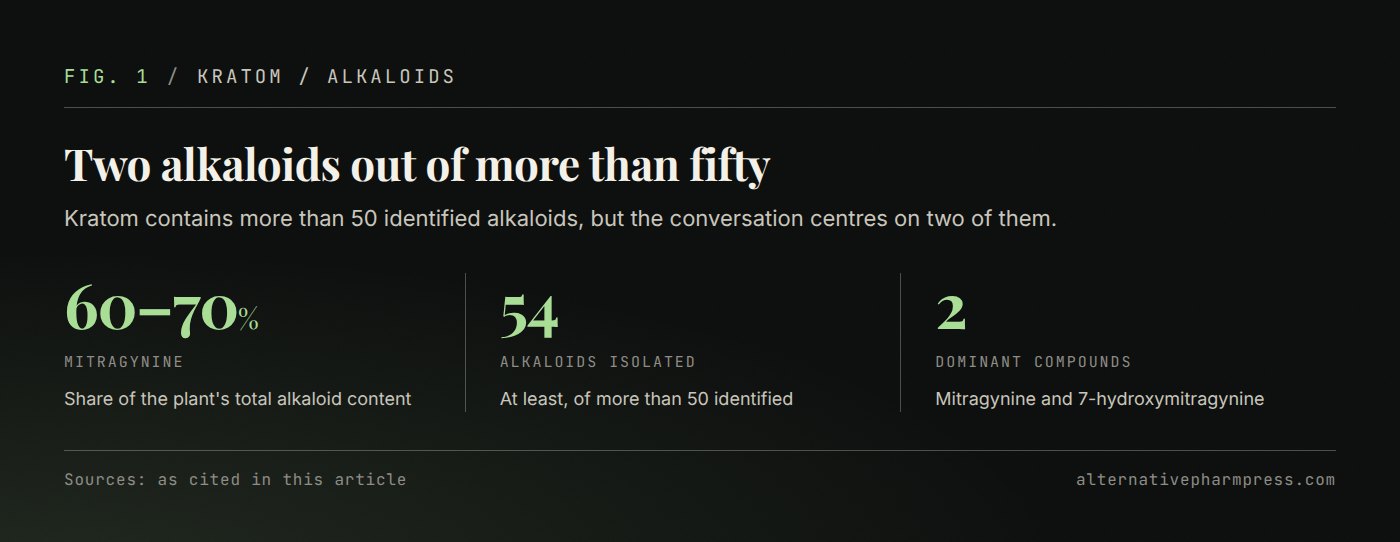
Mitragynine typically makes up 1 to 2% of dry leaf mass and up to about two-thirds of total alkaloid content. 7-OH is usually present at under 0.05% of dried leaf.1 The FDA puts natural 7-OH at less than 2% of total alkaloids.4 In the leaf powder used in a 2024 clinical trial, mitragynine was about 1.33% and 7-OH below 0.01%.9
Where leaf 7-OH comes from is still debated. One clinical team describes trace amounts forming by spontaneous oxidation of mitragynine,10 and Malaysian researchers did not detect 7-OH in decoction made from freshly harvested leaves in a preliminary analysis.11 Either way, 7-OH levels well above those in raw leaf are a red flag: a 2016 study found several commercial kratom products with 7-OH concentrations substantially higher than raw leaves, suggesting adulteration.12
Receptor potency: mitragynine vs 7-hydroxymitragynine
The first detailed receptor study of kratom alkaloids found that mitragynine and 7-OH are both partial agonists at the human mu-opioid receptor and competitive antagonists at kappa and delta opioid receptors. Both were G-protein-biased: they activated the receptor without recruiting β-arrestin, a pathway linked to some opioid side effects.5 In that work, 7-OH (EC50 34.5 nM, maximal effect 47%) was about ten-fold more potent than mitragynine (EC50 339 nM, maximal effect 34%).1
A University of Florida comparison found 7-OH had nine-fold higher affinity for the mu receptor. In its receptor activation assay, mitragynine behaved as an antagonist and 7-OH as a partial agonist (maximal effect 41.3%). In rats given injections, 7-OH relieved pain while mitragynine did not, and 7-OH fully substituted for morphine in drug-discrimination tests. The authors concluded that mitragynine combines low-efficacy mu activity with effects at non-opioid receptors.13
In mice, oral 7-OH was a potent pain reliever and more potent than morphine in tail-flick and hot-plate tests.14 HHS says the FDA’s preclinical review found 7-OH roughly two to nine times more potent than morphine, depending on the study.15
“Biased agonist” is not the same as “safe”. These are cell and animal findings, and human 7-OH use has been linked to dependence and withdrawal (see below). Our overview of kratom and opioid receptor research covers the wider evidence.
Why mitragynine still matters
Mitragynine is not simply a weaker 7-OH. In mice it reached brain concentrations very high relative to its opioid receptor affinity, which the researchers read as a sign that it does not directly activate those receptors much on its own.1 Earlier rodent work had found mitragynine paradoxically more potent as a pain reliever when swallowed than when injected under the skin, which pointed to an active metabolite formed in the gut and liver.1 In rats it also changed how morphine acted, increasing the potency of morphine’s discriminative effects while reducing its pain relief.13
7-OH, by contrast, behaves like a classic opioid in animal studies. Mice given it repeatedly developed tolerance as they do to morphine, showed cross-tolerance with morphine in both directions, and had naloxone-induced withdrawal signs equal to morphine-treated mice.16
Metabolism: how mitragynine becomes 7-OH
In human liver preparations, mitragynine is mainly metabolised by CYP3A4, with minor roles for CYP2D6 and CYP2C9, and CYP3A4 forms 7-OH as one of its oxidative metabolites.6 A Columbia University and Memorial Sloan Kettering team showed the conversion happens in mouse and human liver preparations and in living mice, and that brain levels of the resulting 7-OH were enough to explain most or all of mitragynine’s opioid-receptor-mediated pain relief in mice.1
Human data now support this. In a Thai study, volunteers drank kratom tea containing 23.6 mg of mitragynine; 7-OH exposure was about 20% of mitragynine’s, and pretreatment with the CYP3A4 inhibitor itraconazole reduced 7-OH formation.17 In the 2024 leaf trial, mean 7-OH to mitragynine blood ratios were 0.20 to 0.31 after a single dose.9
Two practical points follow. First, drugs that inhibit or induce CYP3A4 may change how much 7-OH someone makes from kratom; see kratom and drug interactions. Second, mitragynine’s oxidation does not stop at 7-OH. In mice it also yields mitragynine pseudoindoxyl and 3-dehydromitragynine, which the researchers called potentially toxic.18
Blood-brain barrier and half-life
Getting into the brain is a separate question from receptor potency. In rats, less than 10% of unbound mitragynine and 7-OH in plasma crossed the blood-brain barrier, and mitragynine showed 18-fold higher uptake into brain tissue than 7-OH.19 Our 7-OH and the blood-brain barrier overview explains what that means.
In people taking leaf powder, mitragynine lasted much longer in blood than 7-OH: mean half-lives of up to 43.4 hours after one dose versus 4.7 hours for 7-OH.9 For detection windows, see how long 7-OH stays in your system.
Kratom leaf vs 7-OH products: what the difference means in practice
Someone using kratom leaf mainly takes in mitragynine and gets 7-OH second-hand, at a rate set by their own CYP3A4 activity. In the 2024 leaf trial, blood 7-OH stayed at roughly a fifth to a third of mitragynine levels after a single dose.9 Someone using a 7-OH tablet or film takes the potent compound directly, often in amounts the DEA puts as high as 700 mg a serving,7 and sometimes by routes that skip first-pass liver metabolism.10 In human blood, some of that 7-OH can then convert to the even more potent pseudoindoxyl.20
This is why researchers, the FDA and the DEA now treat the two as distinct, and why leaf-based safety data cannot be applied to 7-OH products.
Mitragynine pseudoindoxyl: the next step
Mitragynine pseudoindoxyl (MP) is a rearrangement product of 7-OH with the same molecular formula.7,3 In laboratory tests, 7-OH was stable in rodent and monkey plasma but in human plasma was converted to MP, an opioid even more potent than mitragynine or 7-OH.20 MP acts as a mu agonist and delta antagonist and did not recruit β-arrestin-2 in cell studies.21 The DEA describes MP as about 100 times more potent than mitragynine at the mu receptor in preclinical data, and as a semi-synthetic opioid made from purified mitragynine or 7-OH.7
Semi-synthetic 7-OH products
The 7-OH products now sold in the US are semi-synthetic, not leaf.10 Between September 2024 and February 2025, researchers found 304 semi-synthetic 7-OH and MP products online: 82.2% were 7-OH-only tablets, shots or gummies, and 92% of 7-OH-only products were advertised as “kratom”. The mean cost per recommended serving was $3.97.22 The DEA reports 7-OH products ranging from 1 mg to 700 mg in a single serving.7
Labels are often unreliable. A 2026 analysis of tablets, films and shots found frequent mismatches between labelled and actual alkaloids, with unlisted compounds including 7-OH and 3-dehydromitragynine.23 Some products are designed for under-the-tongue or nasal use, routes that bypass first-pass liver metabolism and speed onset. In one case report, a man developed tolerance within days of starting a 7-OH film and severe substance use disorder within weeks.10
For buyers, the key point is that 7-OH products are a different category from leaf. See 7-OH vs traditional kratom and, for those trying to stop, 7-OH withdrawal.
Legal status in October 2026
In July 2025 the FDA recommended scheduling certain 7-OH products, saying the action was not focused on natural kratom leaf.24 On 26 August 2026 a DEA temporary order placed MP, MGM-15 and MGM-16 in Schedule I, effective through 26 August 2028 with a possible one-year extension.25
On 14 October 2026 the DEA published a revised notice of intent (FR Doc. 2026-20943, Docket DEA-1570) to temporarily place 7-OH and MP in Schedule I above a threshold. A product would be covered if either substance alone, or both combined, exceeds 1 mg per gram for solids or 1 mg per mL for liquids, or if the mass ratio of mitragynine to 7-OH (or 7-OH plus MP) is below 100. The order cannot be published before 13 November 2026, and the DEA intends it to replace the no-threshold MP order.7
Mitragynine and plain kratom leaf are not scheduled by this action. The DEA notes that botanical kratom contains trace 7-OH, and that below-threshold products are not thereby deemed safe.7 As of 24 October 2026, 7-OH is not yet federally scheduled. Our tracker on 7-OH scheduling in 2026 follows each step.
Testing: lab reports and drug tests
Product testing. The ratio test makes a full alkaloid panel essential. A certificate of analysis that reports mitragynine and 7-OH (and ideally MP) in mg per gram lets a buyer check both the concentration and the ratio. A product listing mitragynine alone tells you nothing about added 7-OH. Our guide on reading a kratom COA explains what to look for.
Drug tests. Specialised urine methods can quantify mitragynine and monitor 7-OH and other metabolites.26 Because 7-OH has a shorter half-life, clinicians reporting a 7-OH case noted that standard laboratory testing can detect mitragynine but not 7-OH, which can make semi-synthetic 7-OH use look like kratom use.10 See does kratom show up on a drug test?
Frequently asked questions
What is the difference between mitragynine and 7-hydroxymitragynine?
Mitragynine is kratom’s most abundant alkaloid, about 1 to 2% of dried leaf. 7-OH is an oxidised form with one extra oxygen, usually under 0.05% of leaf.1 7-OH is about ten times more potent at the mu-opioid receptor in lab tests, and it is the compound the DEA plans to schedule above a threshold.7
Is 7-OH stronger than mitragynine?
Yes, at opioid receptors. 7-OH was about ten-fold more potent than mitragynine at the human mu-opioid receptor in cell assays,1 and in rats it relieved pain where mitragynine did not.13 HHS says FDA’s review found 7-OH roughly two to nine times more potent than morphine in preclinical studies.15
Does the body turn mitragynine into 7-OH?
Yes. The liver enzyme CYP3A4 converts some mitragynine into 7-OH.6 In a human study, 7-OH exposure after kratom tea was about 20% of mitragynine’s, and the CYP3A4 inhibitor itraconazole reduced its formation.17 Mouse research suggests this metabolite explains most of mitragynine’s opioid-like pain relief.1
Is 7-hydroxymitragynine natural or synthetic?
Both. Trace amounts occur in kratom leaf, under 2% of total alkaloids according to the FDA.4 The 7-OH products now on sale, however, are described by researchers as semi-synthetic, and 7-OH can be made from mitragynine in a one-step reaction.7 Commercial kratom products with far more 7-OH than raw leaf have been reported since at least 2016.12
Is mitragynine being banned along with 7-OH?
No. The DEA’s 14 October 2026 notice covers 7-OH and mitragynine pseudoindoxyl above a threshold, not mitragynine or plain kratom leaf.7 The order cannot be published before 13 November 2026. Some states have their own kratom or 7-OH rules, so check local law.
Is 7-OH the same as kratom?
No. 7-hydroxymitragynine is one alkaloid found in small amounts in kratom leaf. Mitragynine is the main alkaloid. Most "7-OH" products are concentrated or semi-synthetic and much stronger than leaf.
Sources
- Kruegel AC, Uprety R, Grinnell SG, Langreck C, Pekarskaya EA, Le Rouzic V, et al. 7-Hydroxymitragynine Is an Active Metabolite of Mitragynine and a Key Mediator of Its Analgesic Effects. ACS Cent Sci. 2019;5(6):992-1001. DOI: 10.1021/acscentsci.9b00141. PMID: 31263758. pubmed.ncbi.nlm.nih.gov
- National Center for Biotechnology Information. PubChem Compound Summary for CID 3034396, Mitragynine. pubchem.ncbi.nlm.nih.gov
- National Center for Biotechnology Information. PubChem Compound Summaries for CID 44301524, 7-Hydroxymitragynine, and CID 44301701, Mitragynine pseudoindoxyl. pubchem.ncbi.nlm.nih.gov
- US Food and Drug Administration. FDA and Kratom. Content current as of 2 December 2025. fda.gov
- Kruegel AC, Gassaway MM, Kapoor A, Váradi A, Majumdar S, Filizola M, et al. Synthetic and Receptor Signaling Explorations of the Mitragyna Alkaloids: Mitragynine as an Atypical Molecular Framework for Opioid Receptor Modulators. J Am Chem Soc. 2016;138(21):6754-6764. DOI: 10.1021/jacs.6b00360. PMID: 27192616. pubmed.ncbi.nlm.nih.gov
- Kamble SH, Sharma A, King TI, León F, McCurdy CR, Avery BA. Metabolite profiling and identification of enzymes responsible for the metabolism of mitragynine, the major alkaloid of Mitragyna speciosa (kratom). Xenobiotica. 2019;49(11):1279-1288. DOI: 10.1080/00498254.2018.1552819. PMID: 30547698. pubmed.ncbi.nlm.nih.gov
- Drug Enforcement Administration. Schedules of Controlled Substances: Temporary Placement of 7-Hydroxymitragynine and Mitragynine Pseudoindoxyl Above a Specified Threshold in Schedule I. 91 FR 65370, FR Doc. 2026-20943, Docket DEA-1570. 14 October 2026. federalregister.gov
- Basiliere S, Kerrigan S. Temperature and pH-Dependent Stability of Mitragyna Alkaloids. J Anal Toxicol. 2020;44(4):314-324. DOI: 10.1093/jat/bkz103. PMID: 31897484. pubmed.ncbi.nlm.nih.gov
- Huestis MA, Brett MA, Bothmer J, Atallah R. Human Mitragynine and 7-Hydroxymitragynine Pharmacokinetics after Single and Multiple Daily Doses of Oral Encapsulated Dried Kratom Leaf Powder. Molecules. 2024;29(5):984. DOI: 10.3390/molecules29050984. PMID: 38474495. pubmed.ncbi.nlm.nih.gov
- Reif B, Adkins A, Boyer EW, Kanumuri SRR, Sharma A, Smith KE. Substance Use Disorder Following Consumption of a Novel Synthetic 7-Hydroxymitragynine Product. J Addict Med. 2025 (published online 5 November 2025). DOI: 10.1097/ADM.0000000000001603. PMID: 41189061. pubmed.ncbi.nlm.nih.gov
- Karunakaran T, Vicknasingam K, Chawarski MC. Kratom-labeled Products in the US Compared With Traditionally Consumed Natural Kratom in Southeast Asia. J Addict Med. 2026 (published online 20 October 2026). DOI: 10.1097/ADM.0000000000001785. PMID: 42822000. pubmed.ncbi.nlm.nih.gov
- Lydecker AG, Sharma A, McCurdy CR, Avery BA, Babu KM, Boyer EW. Suspected Adulteration of Commercial Kratom Products with 7-Hydroxymitragynine. J Med Toxicol. 2016;12(4):341-349. DOI: 10.1007/s13181-016-0588-y. PMID: 27752985. pubmed.ncbi.nlm.nih.gov
- Obeng S, Wilkerson JL, León F, Reeves ME, Restrepo LF, Gamez-Jimenez LR, et al. Pharmacological Comparison of Mitragynine and 7-Hydroxymitragynine: In Vitro Affinity and Efficacy for μ-Opioid Receptor and Opioid-Like Behavioral Effects in Rats. J Pharmacol Exp Ther. 2021;376(3):410-427. DOI: 10.1124/jpet.120.000189. PMID: 33384303. pubmed.ncbi.nlm.nih.gov
- Matsumoto K, Horie S, Ishikawa H, Takayama H, Aimi N, Ponglux D, et al. Antinociceptive effect of 7-hydroxymitragynine in mice: Discovery of an orally active opioid analgesic from the Thai medicinal herb Mitragyna speciosa. Life Sci. 2004;74(17):2143-2155. DOI: 10.1016/j.lfs.2003.09.054. PMID: 14969718. pubmed.ncbi.nlm.nih.gov
- US Department of Health and Human Services. HHS Recommends Science-Based Thresholds to Target Dangerous Enhanced Kratom Products. 9 October 2026. hhs.gov
- Matsumoto K, Horie S, Takayama H, Ishikawa H, Aimi N, Ponglux D, et al. Antinociception, tolerance and withdrawal symptoms induced by 7-hydroxymitragynine, an alkaloid from the Thai medicinal herb Mitragyna speciosa. Life Sci. 2005;78(1):2-7. DOI: 10.1016/j.lfs.2004.10.086. PMID: 16169018. pubmed.ncbi.nlm.nih.gov
- Mongar P, Jaisi A, Inkviya T, Wungsintaweekul J, Wiwattanawongsa K. Effects of Itraconazole on Pharmacokinetics of Mitragynine and 7-Hydroxymitragynine in Healthy Volunteers. ACS Pharmacol Transl Sci. 2024;7(3):823-833. DOI: 10.1021/acsptsci.3c00335. PMID: 38481700. pubmed.ncbi.nlm.nih.gov
- Chakraborty S, Uprety R, Slocum ST, Irie T, Le Rouzic V, Li X, et al. Oxidative Metabolism as a Modulator of Kratom’s Biological Actions. J Med Chem. 2021;64(22):16553-16572. DOI: 10.1021/acs.jmedchem.1c01111. PMID: 34783240. pubmed.ncbi.nlm.nih.gov
- Yusof SR, Mohd Uzid M, Teh EH, Hanapi NA, Mohideen M, Mohamad Arshad AS, et al. Rate and extent of mitragynine and 7-hydroxymitragynine blood-brain barrier transport and their intra-brain distribution: the missing link in pharmacodynamic studies. Addict Biol. 2019;24(5):935-945. DOI: 10.1111/adb.12661. PMID: 30088322. pubmed.ncbi.nlm.nih.gov
- Kamble SH, León F, King TI, Berthold EC, Lopera-Londoño C, Siva Rama Raju K, et al. Metabolism of a Kratom Alkaloid Metabolite in Human Plasma Increases Its Opioid Potency and Efficacy. ACS Pharmacol Transl Sci. 2020;3(6):1063-1068. DOI: 10.1021/acsptsci.0c00075. PMID: 33344889. pubmed.ncbi.nlm.nih.gov
- Váradi A, Marrone GF, Palmer TC, Narayan A, Szabó MR, Le Rouzic V, et al. Mitragynine/Corynantheidine Pseudoindoxyls As Opioid Analgesics with Mu Agonism and Delta Antagonism, Which Do Not Recruit β-Arrestin-2. J Med Chem. 2016;59(18):8381-8397. DOI: 10.1021/acs.jmedchem.6b00748. PMID: 27556704. pubmed.ncbi.nlm.nih.gov
- Hill K, Boyer EW, Grundmann O, Smith KE. De facto opioids: Characterization of novel 7-hydroxymitragynine and mitragynine pseudoindoxyl product marketing. Drug Alcohol Depend. 2025;272:112701. DOI: 10.1016/j.drugalcdep.2025.112701. PMID: 40373645. pubmed.ncbi.nlm.nih.gov
- Gour A, Kanumuri SRR, Mukhopadhyay S, Pullman MK, León F, Cutler SJ, et al. Mislabeling and Status of Semisynthetic Kratom-Derived Products in the US Market. Drug Test Anal. 2026;18(10):1286-1295. DOI: 10.1002/dta.70122. PMID: 42448619. pubmed.ncbi.nlm.nih.gov
- US Food and Drug Administration. FDA Takes Steps to Restrict 7-OH Opioid Products Threatening American Consumers. 29 July 2025. fda.gov
- Vicente LLP. DEA Places Three Kratom-Related Substances in Schedule I as 7-OH Scheduling Remains Pending. 9 September 2026. vicentellp.com
- Le D, Goggin MM, Janis GC. Analysis of mitragynine and metabolites in human urine for detecting the use of the psychoactive plant kratom. J Anal Toxicol. 2012;36(9):616-625. DOI: 10.1093/jat/bks073. PMID: 23024321. pubmed.ncbi.nlm.nih.gov
This article is for educational purposes only and is not medical or legal advice. Products discussed here are not intended to diagnose, treat, cure or prevent any disease. Laws vary by location and change often, so verify the rules that apply where you are. Always talk to a licensed healthcare provider before use, especially if you are under 21, pregnant or nursing, taking medication, or managing a health condition.